
The key ideas
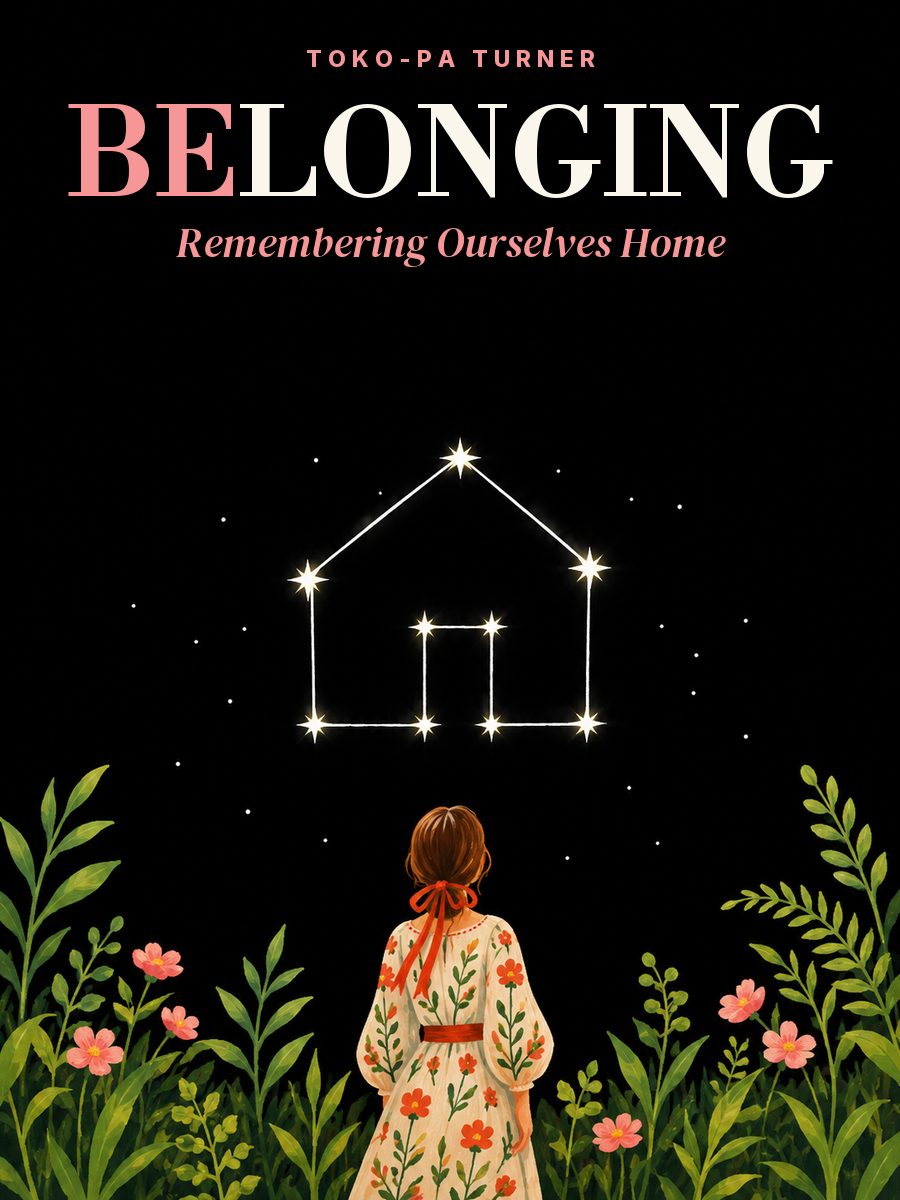
Belonging: Remembering Ourselves Home
Do you know the feeling that everyone around you is inside and you are outside? Toko-pa Turner, who left home at fifteen and spent a long time looking for her place, explains where this feeling comes from. Her conclusion: belonging is not found ready-made, it is grown, like a living bridge of roots, through people, place and the courage to be yourself.
Who it is for
For anyone who misses having their own people after a move, and for everyone who feels outside the circle.
What if belonging isn't a place at all, but a skill: a set of competencies that we, in modern life, have lost or forgotten?
The stairs where you wait
As a little girl, after yet another hurt, Toko-pa would run from the family table to her room and wait for her mother to come up and call her back. Her mother didn't come. Then the girl would sit on the stairs by the kitchen and listen to the family eating dinner without her.
Toko-pa Turner grew up in a Sufi community in Montreal, left home at fifteen and spent several years moving between shelters for teenagers. Later she began working with dreams, and in 2001 her Dream School came into being. She writes her book not as an expert, but as an orphan who had to search a long time for her place.
Turner notes that hardly anyone talks out loud about not belonging. So each of us feels as if everyone else is inside and only we are outside. The author suggests looking at it differently: perhaps belonging is not a place you find once, but a skill. And this skill can be learned.
Hiding so as not to be in the way
Once Turner found herself without a home and lived in the spare room of a friend and her husband. After a few weeks she began to feel she was in the way, although her hosts gave her no reason to. At first she bought groceries, cooked and cleaned, then she started going out for long stretches or shutting herself in her room.
One morning her friend asked what was wrong. Turner couldn't say it out loud and wrote on a piece of paper: "I feel like I'm in the way." Her friend didn't comfort her. She said that by keeping away from the shared life of the house, Turner was the one doing the abandoning.
Then the author saw how many times she had left first so as not to be left. Behind it lay the same hope as on the stairs: that someone might notice she was gone. In her view this goes back to childhood: a child is told they are too loud or too dramatic, and they hide those traits in order to be accepted.
There is another trick too: like a chameleon, quickly taking on the customs of any new place. But in Turner's experience, such flexibility doesn't bring real belonging. As long as we show only a smoothed-over version of ourselves, the author believes, we deprive both ourselves and those who could be close to us of belonging.
About the author
Canadian writer Toko-pa Turner works with dreams. She grew up in a Sufi community in Montreal, founded the Dream School in 2001, and Belonging was her first book.
All books by this author: Toko-pa Turner
Belonging: Remembering Ourselves Home Quiz
Terms from the book
- chameleon
- guru
- Grimm
- initiation
- Craig
- Sufi: A follower of Sufism, a mystical movement within Islam. Turner grew up in a Sufi community in Montreal, where people prayed, sang and danced together a great deal.
- Dream School: A school of dreamwork that Turner founded in 2001. It began with small talks in a local library.
- Jenna: A woman Turner became friends with after moving to a new town. The friendship broke off when Turner left Jenna's spiritual community.
- false belonging: A phrase of the poet John O'Donohue that Turner takes into her book: membership of a group, a job or a relationship on condition that you give up part of yourself. It is an image, not a scientific term.
- O'Donohue: John O'Donohue, an Irish poet and philosopher who wrote about Celtic spirituality. Turner quotes his words about the trap of false belonging.
- glass ceiling: An invisible limit above which a person is not allowed to rise. Turner uses it for the moment when you can no longer grow in a group while remaining yourself.
- dark guests: An image from the book: difficult feelings such as anger, impatience, shame and grief that arrive uninvited. Turner advises not driving them away but finding out what they want to say.
Similar books
- Beyond Order: 12 More Rules for Life, Jordan B. Peterson
- Build the Life You Want: The Art and Science of Getting Happier, Arthur C. Brooks, Oprah Winfrey
- Change Your Thoughts, Change Your Life, Wayne Dyer
- Chatter: The Voice in Our Head, Why It Matters, and How to Harness It, Ethan Kross
- The Cosmic Ordering Service: A Guide to Realizing Your Dreams, Barbel Mohr
- Courage Is Calling, Ryan Holiday
- Death and Its Mystery: Before Death, Camille Flammarion
- Discipline Is Destiny: The Power of Self-Control, Ryan Holiday
- Mental Efficiency, Arnold Bennett
- Propaganda, Edward Bernays