
The key ideas
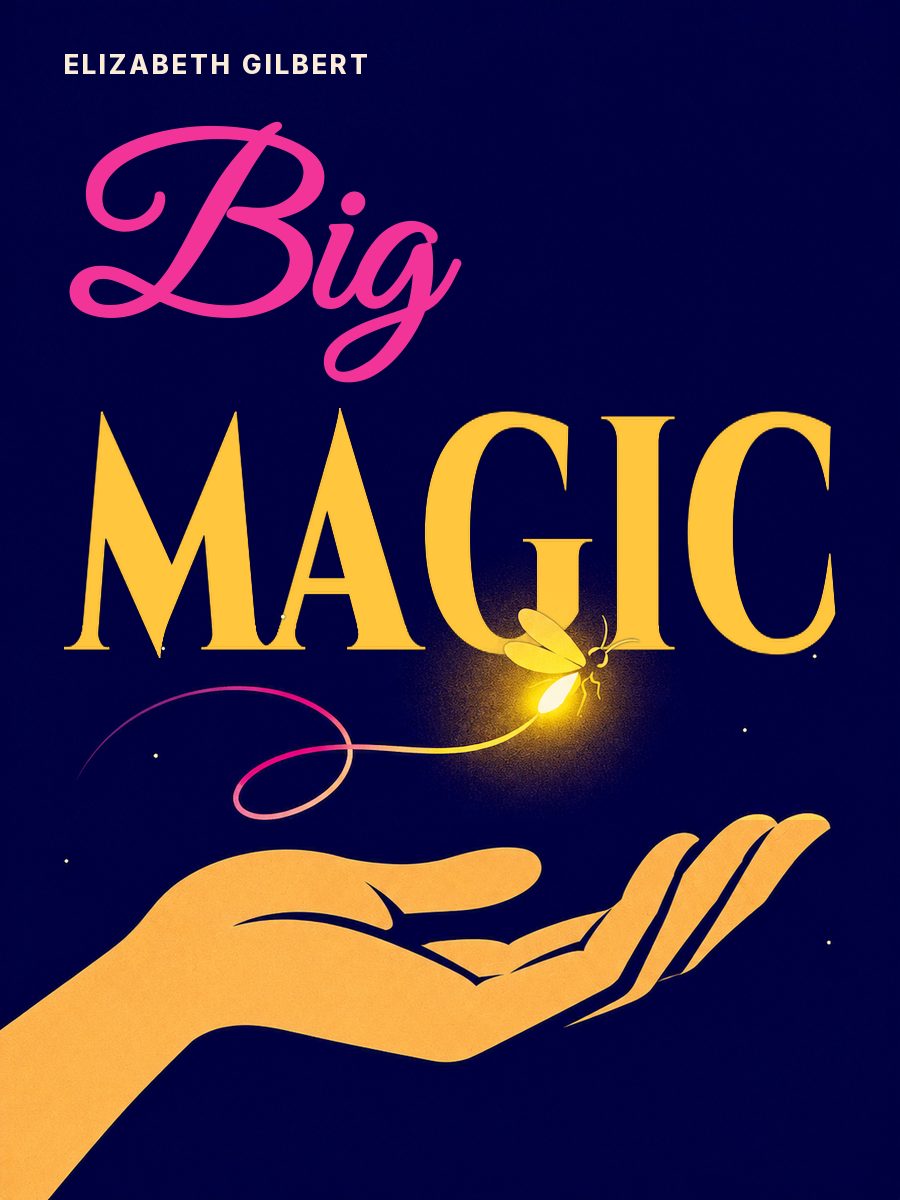
Big Magic
Why do some people carry a book, a song or a painting inside them for years while others simply sit down and make it? Elizabeth Gilbert, the author of Eat Pray Love, talks about how to handle fear, where ideas go and why creativity doesn’t have to feed you or torment you. This is a book about a life in which curiosity matters more than fear.
Who it is for
For anyone who once drew, wrote, sang or sewed and gave it up because it wasn’t “serious,” and for anyone who creates but suffers every time.
Creativity is the path of the brave, but not of the fearless.
Skates at forty
Elizabeth Gilbert’s friend Susan figure skated as a child but gave it up as a teenager, once it was clear she would never be a champion. For twenty-five years she didn’t go near a rink. At forty she was overcome by gloom and asked herself when she had last felt light and alive. The answer stunned her: back then, on the ice.
Susan bought skates, found a coach and began skating three times a week at dawn among nine-year-old girls. She didn’t quit her job, and she didn’t win any medals. But this is exactly what Gilbert calls creative living: a life driven by curiosity, not by fear.
In Big Magic, the author of Eat Pray Love gathered everything that years of writing had taught her about fear, ideas, money and failure. Her main point is this: there are treasures hidden in each of us, and digging them out takes not genius but courage.
Fear as a fellow passenger
As a child Gilbert was afraid of almost everything: snow, stairs, the telephone, the ocean. Her mother answered every fear the same way. Afraid of the ocean? Get in the water. Afraid of the phone? Now you answer every call in the house. As a teenager Gilbert realized she was spending her energy defending her own weakness, and she decided she no longer wanted to defend it.
Then she noticed something else: her fear is boring. It sings one note, “Stop!”, and it sounds the same in everyone. Even a tadpole in a petri dish flinches when a shadow passes over it. What can be special, in the author’s view, are our dreams and abilities, while fear is the most ordinary thing about us.
Gilbert doesn’t suggest getting rid of it. For her, fear and creativity are like conjoined twins: whoever tries to kill fear often kills creativity too. So before every new project she addresses her fear as a fellow passenger in the car. It can ride along and speak its mind. But it isn’t allowed to touch the map, the radio or the air conditioning, let alone the wheel.
About the author
Elizabeth Gilbert is an American writer and journalist. By her own account, her memoir Eat Pray Love has been read by more than twelve million people.
All books by this author: Elizabeth Gilbert
Terms from the book
- James
- Brown
- Susan
- Morrison
- Felipe: A Brazilian man, Elizabeth Gilbert’s partner and later her husband. He was not allowed into the United States, and for his sake Gilbert went abroad for almost a year.
- Patchett: Ann Patchett, an American writer. Gilbert sees her novel State of Wonder (2011), about a journey into the Amazon jungle, as the book her own idea passed to.
- genius: To the ancient Romans, a guardian spirit who lives beside a person and helps them with their work. Gilbert reminds us that the Romans said “he has a genius,” not “he is a genius.”
- Manson: Mark Manson, an American blogger and author of self-help books. Gilbert retells his post about how every pursuit has its own unpleasant side.
- Arnold-Ratliff: Katie Arnold-Ratliff, an American writer. In the book her story shows how the belief that suffering is required kept her from writing for years.
- trickster: A character from myths and folktales, a sly rogue who doesn’t fight the world but outwits it. In the book it is an image of a light, playful attitude to work, the opposite of the martyr.
- Esquire: An American men’s magazine. In 1993 it ran Gilbert’s first published story.
- wisteria: A climbing plant with long hanging clusters of lilac flowers.
Similar books
- Blink: The Power of Thinking Without Thinking, Malcolm Gladwell
- Breaking the Habit of Being Yourself: How to Lose Your Mind and Create a New One, Joe Dispenza
- Can't Hurt Me, David Goggins
- Daring Greatly, Brené Brown
- The Autobiography of Charles Darwin, Charles Darwin
- Deep Work: Rules for Focused Success in a Distracted World, Cal Newport
- Designing Your Life, Bill Burnett, Dave Evans
- Digital Minimalism, Cal Newport
- The Black Swan, Nassim Nicholas Taleb
- Blue Ocean Strategy: How to Create Uncontested Market Space and Make the Competition Irrelevant, W. Chan Kim, Renée Mauborgne