
The key ideas
The Art of Acting Wisely
Why does the brochure for an expensive degree look like a good deal, a candidate’s promise sound convincing and a neighbor’s success hurt so much? Rolf Dobelli collected another 52 errors that smart people make less in their thoughts than in their actions. His approach is simple: don’t look for the secret of success, remove what destroys it.
Who it is for
For people who make decisions about money, work and other people and notice that a confident choice often turns out badly later. And for readers of The Art of Thinking Clearly who want to know what came next.
We have not learned how to solve difficult business problems. What we have learned is to avoid them.
Not what to do, but what not to do
Warren Buffett, one of the best-known investors in the world, said something surprising about himself and his partner Charlie Munger. They never learned to solve difficult business problems. They learned to avoid them.
The Swiss writer Rolf Dobelli turns this thought into a program. Nobody knows for sure what makes us successful and happy, he admits. But we know very well what destroys both success and happiness. Following Nassim Taleb, the author calls this approach by its Latin name, via negativa, the negative way: get rid of the foolish actions, and the sensible ones will come by themselves.
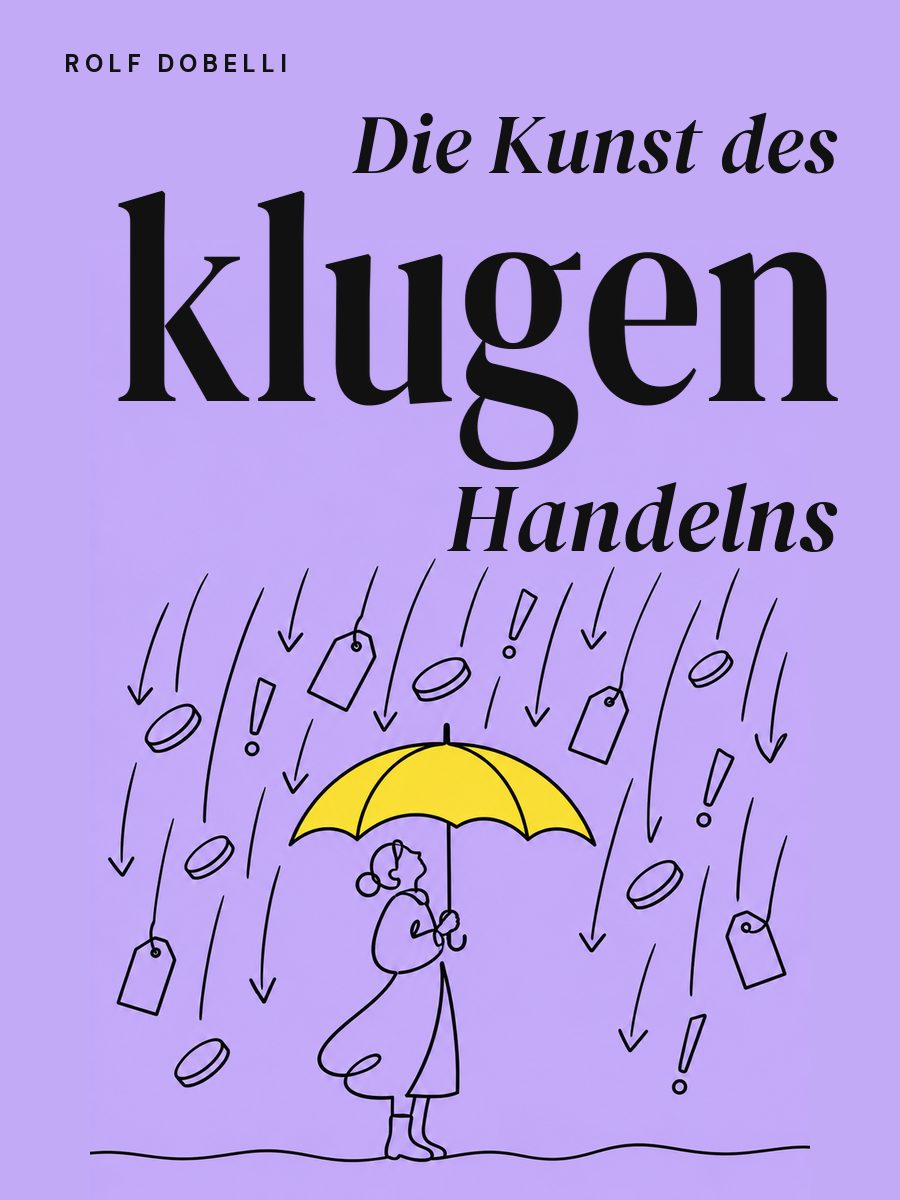
This book came out in German in 2012 as Die Kunst des klugen Handelns, the sequel to The Art of Thinking Clearly, and it too grew out of newspaper columns. It has another 52 traps, and Dobelli honestly writes that there is no difference between errors of thinking and errors of acting: he simply needed a new title. The first book looked at how we see the world. From the second, this retelling takes the errors that hit our actions: our money, our dealings with people and our peace of mind.
It is a collection of short essays, not a scientific work, and the author’s tone is sharp. Ahead are five traps you can easily meet in everyday life.
A stadium versus an empty meadow
Dobelli takes apart the brochure for an MBA program, the expensive Master of Business Administration degree. On the last page there is a calculation: the course costs 100,000 euros and by retirement will bring in 400,000 euros more than an ordinary salary. The gain looks obvious.
The author finds several holes in the calculation. For two years of study you earn no salary, so the real price is closer to 200,000. Calculating income thirty years ahead is, in his words, foolish: nobody knows what the world will look like. But the main hole is a different one. The brochure compares the MBA with a life without any study at all and says nothing about a cheaper course that could give the same boost.
The name of this trap is alternative blindness. We compare an offer with what we have now, not with the best thing we could do instead. Supporters of a new stadium say an arena is better than an empty meadow. The honest comparison is a different one: the stadium versus a school, a hospital or selling the land.
According to Dobelli, this is exactly what Buffett does: he compares every deal with the best alternative available at that moment. The author’s advice: when a choice looks like “yes or nothing”, name at least two other things the money or the time could go to, and only then decide.
About the author
Rolf Dobelli was born in 1966, earned a doctorate at the University of St. Gallen, ran Swissair subsidiaries and co-founded getAbstract. He writes novels and books about thinking and lives in Lucerne.
All books by this author: Rolf Dobelli
Terms from the book
- MBA
- Matthews
- Buffett
- Taleb
- Via negativa
- Tolstoy
- Aristotle
- Newton
- Munger: Charlie Munger (1924-2023) was an American investor, Warren Buffett’s business partner for many years, known for his sayings about human error.
- Alternative blindness: Dobelli’s name for the error of comparing an offer with the current state of things while forgetting the other options the same resources could go to.
- Strategic misrepresentation: Deliberately making deadlines, benefits or your own abilities look better than they are when a contract, a job or funding depends on the answer. The term comes from research on budgets and large projects.
- Flyvbjerg: Bent Flyvbjerg is a Danish professor at the University of Oxford who studies large infrastructure projects and their cost overruns.
- Inverted Darwinism: Bent Flyvbjerg’s image: in a competition between projects, the one that survives is not the best one but the one that looks best on paper. It is a metaphor, not a term from biology.
- MSNBC: An American cable news channel.
- Greenspan: Alan Greenspan is an American economist who chaired the US Federal Reserve from 1987 to 2006.
- Fallacy of the single cause: The error of looking for one cause of a complex event when a combination of many factors led to it.
- Social comparison bias: The tendency not to support people who might outdo us in our own field. Described in the work of psychologist Stephen Garcia and his colleagues.
- Barrow: Isaac Barrow (1630-1677) was an English mathematician, a Cambridge professor and Isaac Newton’s teacher.
Similar books
- The Art of Thinking Clearly, Rolf Dobelli
- Digital Body Language: How to Build Trust and Connection, No Matter the Distance, Erica Dhawan
- Do More Great Work: Stop the Busywork. Start the Work That Matters., Michael Bungay Stanier
- Drive: The Surprising Truth About What Motivates Us, Daniel Pink
- Earn What You're Really Worth, Brian Tracy
- Everything Is Negotiable, Gavin Kennedy
- Extreme Ownership: How U.S. Navy SEALs Lead and Win, Jocko Willink, Leif Babin
- The Five Dysfunctions of a Team: A Leadership Fable, Patrick Lencioni
- Die with Zero: Getting All You Can from Your Money and Your Life, Bill Perkins
- Difficult Conversations: How to Discuss What Matters Most, Douglas Stone, Bruce Patton, Sheila Heen