
The key ideas
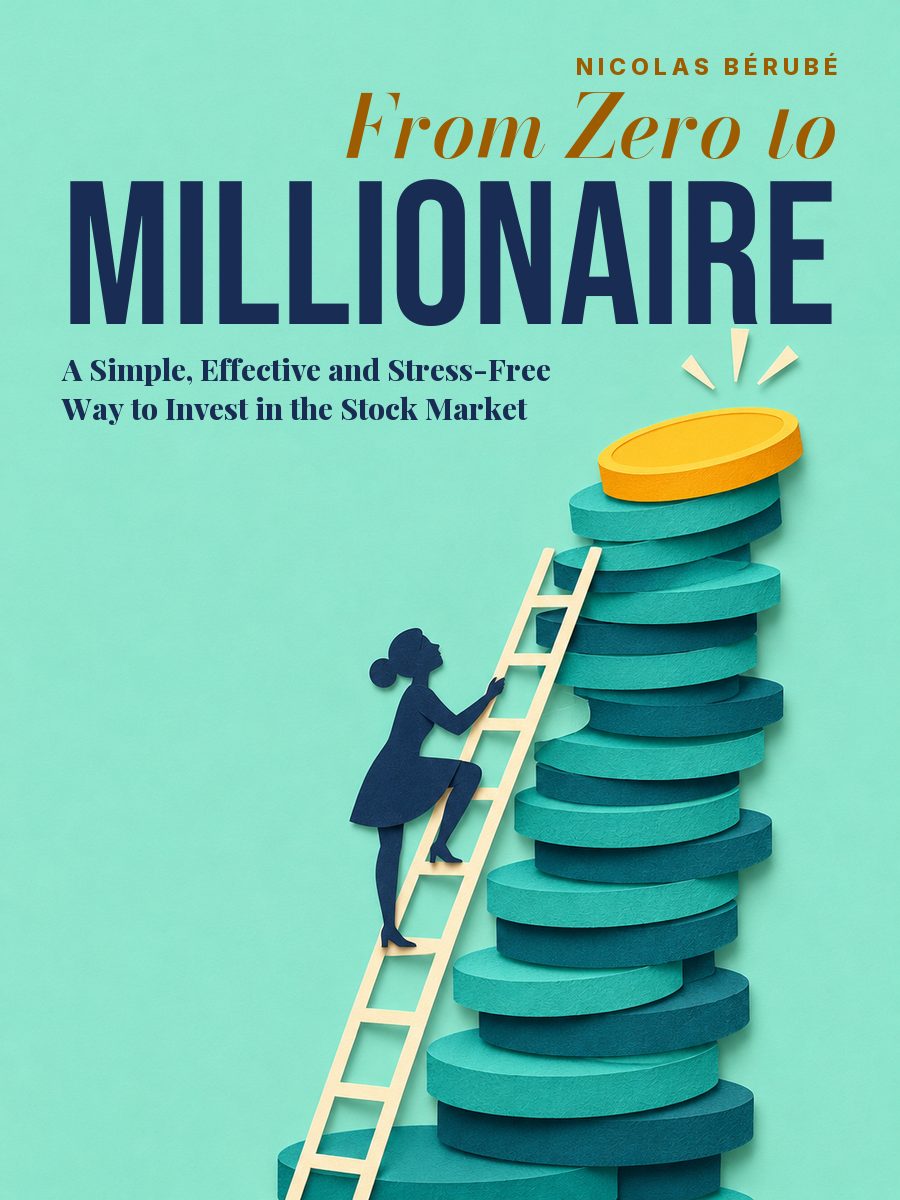
From Zero to Millionaire: A Simple, Effective, and Stress-Free Way to Invest in the Stock Market
Many people are sure that the money on the stock market goes to whoever is first to find the next Apple and gets out before a crash. Canadian journalist Nicolas Bérubé lost money himself by betting against the market, and then spent years reading research and questioning well-known investors. He shows why professionals rarely beat a simple index, what fees really cost, and how to get through a market fall without selling anything.
Who it is for
For people who have long meant to start investing but fear crashes, do not trust their bank and do not understand what they pay an advisor for.
Investing is a simple activity, which a whole industry strives to make complicated to justify its existence.
Ten thousand dollars bet on the end of the world
In 2010 Nicolas Bérubé was thirty-three, lived in Los Angeles and had no doubt that the stock market was about to collapse. America was going through its worst financial crisis since the Great Depression, and after the crash stocks had won back 60% within a few months. He put the ten thousand dollars of profit from selling his apartment in Montreal into put options, that is, securities that gain value when the related stocks fall.
The market kept rising. The money began melting away from the first day, and a few months later he had to sell the options for a few hundred dollars.
The financial journalist at La Presse did not hold a grudge against the stock market; he decided to figure it out. Years of reading and interviews with well-known investors led to an almost boring conclusion: investing wisely is simple, and what makes it complicated is an industry that profits from complexity.
The book's main idea is that an investor's results depend more on their behavior than on their choice of companies. The author's figures come mainly from the U.S. and Canadian markets, and he does not promise endless growth.
Don't guess the podium, bet on the whole peloton
Mohnish Pabrai runs a fund with more than half a billion dollars in assets, and Bérubé once spent half a day with him. Over dinner Pabrai talked about Horsehead Holdings, which recycled zinc and was building a new $500 million plant. Bérubé even thought about putting up to a third of his money into it. He did not, and a few years later the company went bankrupt.
The author calls the belief in such finds the myth of the rare pearl: it seems that whoever finds the future winners gets rich. According to the SPIVA report for mid-2022, 90% of professional funds investing in large U.S. companies fell behind the S&P 500 index over ten years. And in a study the author cites, of more than 25,000 American companies from 1926 to 2016, only 4% accounted for all of the market's gains.
He explains the other path using the Tour de France cycling race. You can bet every year on the three podium finishers, or you can bet on the peloton, the main group of riders. The winner may not be in it, but almost all the strongest riders are there, the weak ones fall behind, and future stars join it. This is how an index fund works: it buys the shares of all the companies in an index and updates the lineup on its own. When John Bogle launched such a fund in 1975, the venture was mocked as “Bogle's Folly.” By the time the book came out, his company Vanguard managed more than seven trillion dollars.
About the author
Nicolas Bérubé writes about finance for the Canadian newspaper La Presse and has received a National Newspaper Award. For seven years he was its correspondent in Los Angeles. This book first came out in Canada in French.
All books by this author: Nicolas Bérubé
Terms from the book
- Cape Cod
- compound interest
- Vanguard
- index fund
- Bogle
- mutual fund
- Fidelity
- bonds
- put options: Exchange contracts that gain value when the price of the related stock or index falls. They are used to insure against a fall or to bet on one.
- La Presse: One of Canada's largest newspapers, published in Montreal in French. The author has written about finance for it for many years.
- Pabrai: Mohnish Pabrai, an American investor born in Mumbai. He runs his own investment fund and usually holds only a few companies in his portfolio.
- Horsehead Holdings: An American zinc recycling company from Pittsburgh. According to the book, it went bankrupt a few years after Pabrai told the author about it.
- SPIVA: A regular report by S&P Global that compares the results of professionally managed funds with market indexes.
- S&P 500: A stock index of the five hundred largest companies whose shares trade on U.S. exchanges. It is used as a yardstick for the whole American market.
- Tour de France: The world's best-known multi-day cycling race, held in France since 1903.
- peloton: The main group of riders in a cycling race. They ride close together to fight less against air resistance.
- Hallam: Andrew Hallam, a Canadian financial writer and investor, author of the book Millionaire Teacher.
- Seyhun: Nejat Seyhun, a professor of finance at the University of Michigan. He studied which days account for most of the market's growth.
- O'Shaughnessy: Patrick O'Shaughnessy, an American investor and host of the investing podcast Invest Like the Best.
Similar books
- Going Infinite, Michael Lewis
- Hedge Fund Market Wizards: How Winning Traders Win, Jack D. Schwager
- I Will Teach You to Be Rich, Ramit Sethi
- The Intelligent Investor, Benjamin Graham
- The Lazy Man's Way to Riches, Joe Karbo
- Reminiscences of a Stock Operator, Edwin Lefèvre
- Extraordinary Popular Delusions and the Madness of Crowds, Charles Mackay
- Market Wizards, Jack Schwager
- Game Theory: A Very Short Introduction, Ken Binmore
- Games People Play, Eric Berne