The key ideas
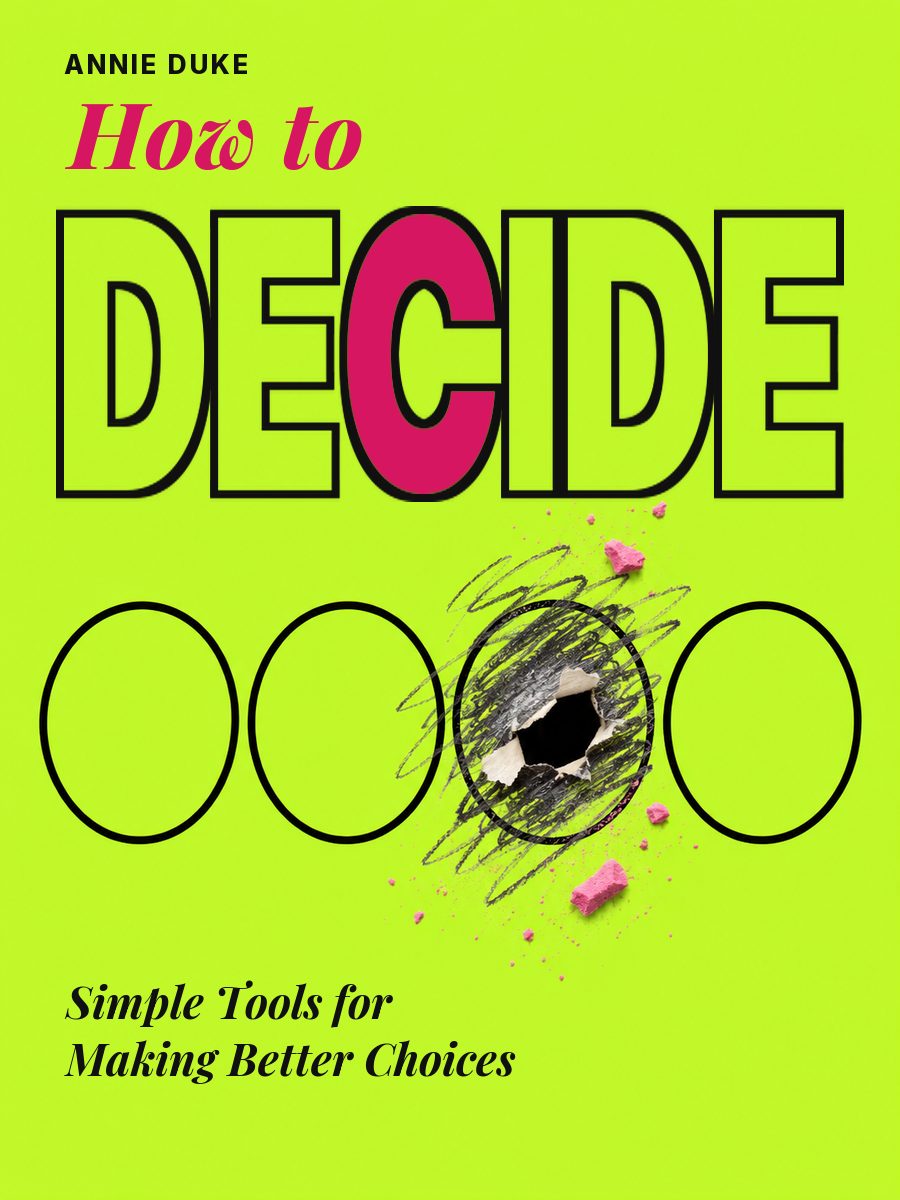
How to Decide: Simple Tools for Making Better Choices
A pros and cons list seems reliable, but it has neither the size of the payoff nor the odds. Former professional poker player Annie Duke replaces it with a set of tools. The set includes a decision tree, the outside view, questions about when you can decide fast, the premortem, and a way to ask for advice so that you hear the truth.
Who it is for
For anyone who agonizes over a choice for weeks, decides by gut feeling or with a pros and cons list, and wants simple tools that can be checked.
When a decision is hard, that means it’s easy.
The best decision that was really the best outcome
Think of your best decision of the past year. Now your worst. Annie Duke has asked hundreds of people these questions and almost always heard the same thing. The best decision was the one that turned out well, and the worst was the one that turned out badly. Almost nobody talked about how they had made the choice.
Duke was a professional poker player and now advises companies. In her book Thinking in Bets, she explained why a bad outcome doesn’t condemn the decision behind it. The new book answers the question that comes next: what to decide with if gut feeling and a pros and cons list won’t do. Your gut, in her words, is a black box: you can’t check how it works, and you can’t pass it on to anyone else.
The author starts from a simple idea. How your life turns out depends on luck and on the quality of your decisions, and only the second is in your control. Ahead are her five main tools.
A tree with only one branch left
Imagine, as Duke suggests, that you come up with an app called Kingdom Comb that sends a hairstylist to the customer’s home. You quit your job and invest your savings and your family’s money. The app never takes off, and after that you trust your gut less and less. In another version of the story, the app is bought for $20 million.
The decision is the same in both versions, which means the futures it opened up are the same too. While the choice still lies ahead, the future looks like a tree: thick limbs for likely outcomes, thin twigs for rare ones. Once the outcome is known, the mind takes a chain saw and cuts off everything but one branch. There are many futures but only one past, and that’s why the past seems inevitable.
Duke advises putting the tree back together and writing down the other outcomes that were possible at the moment of choice. And for a new decision, mark on each branch how much you like that outcome, what you would gain or lose, and how likely it is.
This is the root of her complaint about the pros and cons list. It’s flat: it has neither the size of the payoff nor the probability. The chance of getting to work a little earlier weighs as much on it as the risk of a serious car accident.
About the author
Annie Duke played professional poker for many years, and before that she did graduate work in cognitive science. Today she advises companies on decision making. Her first book on the subject is called Thinking in Bets.
All books by this author: Annie Duke
How to Decide: Simple Tools for Making Better Choices Quiz
Terms from the book
- Base rate
- Premortem
- Klein
- Asch
- Kingdom Comb: A made-up app from Duke’s thought experiment: it sends a hairstylist to the customer’s home. The author uses it to show that one decision opens up many possible outcomes.
- Freeroll: The author’s name for a decision where there is almost nothing to lose and a lot to gain. Such decisions can be made quickly.
- Dr. Evil: The villain of the Austin Powers comedies. Duke gave his name to a game she adapted from one Dan Egan told her about: find decisions that are each easy to justify but that together sink your goal.
- Semmelweis: Ignaz Semmelweis, a 19th-century Hungarian doctor. In Vienna he introduced handwashing before deliveries and sharply reduced deaths among new mothers, but his colleagues rejected him.
Similar books
- Quit: The Power of Knowing When to Walk Away, Annie Duke
- Thinking in Bets: Making Smarter Decisions When You Don't Have All the Facts, Annie Duke
- How to Sell When Nobody's Buying, Dave Lakhani
- Humble Inquiry: The Gentle Art of Asking Instead of Telling, Edgar H. Schein, Peter A. Schein
- The Laws of Human Nature, Robert Greene
- Leaders Eat Last: Why Some Teams Pull Together and Others Don't, Simon Sinek
- Leadership and Self-Deception: Getting Out of the Box, The Arbinger Institute
- Lean Analytics, Alistair Croll and Benjamin Yoskovitz
- How to Do Nothing: Resisting the Attention Economy, Jenny Odell
- How to Live on 24 Hours a Day, Arnold Bennett