The key ideas
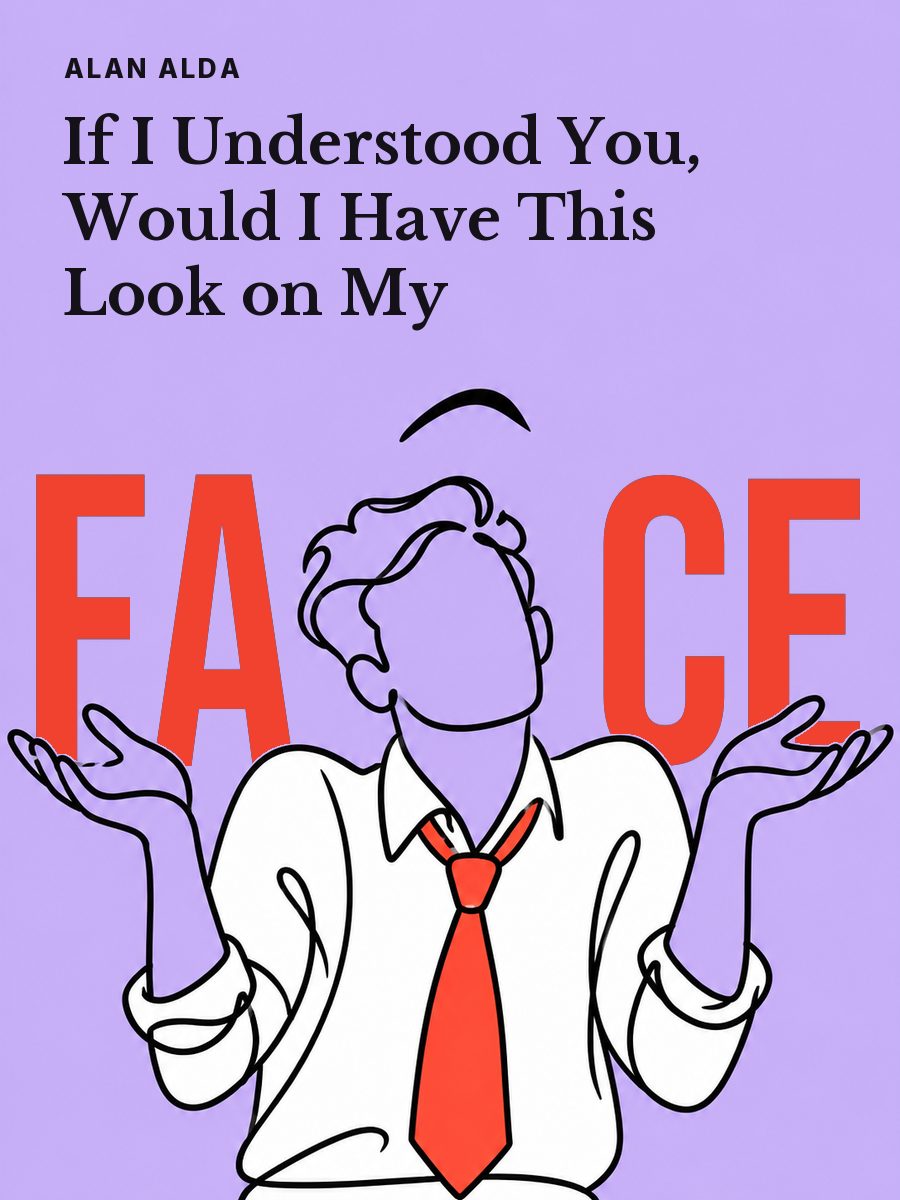
If I Understood You, Would I Have This Look on My Face? My Adventures in the Art and Science of Relating and Communicating
Why do smart people so often fail to understand each other? Actor Alan Alda spent twenty years teaching scientists and doctors to talk with ordinary people, and he found the key in theater improvisation. This book is about noticing what the other person feels and thinks, and speaking so that you're understood.
Who it is for
For anyone who explains things in a way that's perfectly clear to them and gets a blank stare in return. And for anyone who wants to really hear people, not just wait for their turn to talk.
If I tell you something without making sure you got it, did I really communicate anything?
The dentist who looked right through his patient
The dentist already had the scalpel at his patient's mouth, and only then did he say, in one technical word, what he was about to do. The patient asked what he meant, the dentist irritably repeated the same word, and the patient didn't argue. A few seconds later, the frenum of his upper lip was cut. Soon after, on a film set, the director of photography asked the patient why he was sneering instead of smiling: the patient could no longer smile the way he used to.
That patient was the actor Alan Alda. Later he spent twenty years teaching scientists and doctors to talk with ordinary people, and he helped found a center for communicating science at Stony Brook University. And that day the dentist looked at him intently, but he saw an item on his checklist, not a person.
As Alda sees it, this is what's behind most misunderstandings: we aren't truly tuned in to the person we're talking to. He found the key in his own profession. Actors call it relating: the ability to notice what the other person feels and thinks, and to let that change how you respond. Alda is sure anyone can learn it.
To listen is to be ready to change
Alda flubbed his first interview for the science program Scientific American Frontiers within a couple of minutes. He praised a scientist for putting together a solar panel from off-the-shelf parts and saw the man's face tighten: the scientists had made many of the parts themselves. Then Alda gave the panel a pat and was asked not to touch it.
Alda counted three mistakes. He held on to his assumptions, he didn't read the other man's face, and he didn't respond to what was said: he was locked inside his own head.
The director Mike Nichols had once explained to him that relating isn't a decoration on a performance, it's the foundation. An actor says a line not because it's in the script, but because the other actor did something that calls for a response. Theater improvisation teaches this, and Alda carries its lesson into life: if you're just waiting for the other person to finish talking, you aren't listening. To really listen is to let the other person change you.
After that, Alda stopped reading scientists' papers ahead of time and came with nothing but curiosity and an honest lack of knowledge. The scientists could see how much he already understood, and they started explaining from there.
About the author
Alan Alda is an American actor who played Hawkeye on the TV series M*A*S*H and won seven Emmy Awards. For eleven years he hosted the science program Scientific American Frontiers, and he helped found a center that teaches scientists to speak clearly.
All books by this author: Alan Alda
Terms from the book
- Nichols
- Improvisation
- Empathy
- Frenum: A thin fold of tissue between the upper lip and the gum, just above the front teeth.
- Stony Brook: Stony Brook University, part of the State University of New York, on Long Island. It's home to the Alan Alda Center for Communicating Science.
- Scientific American Frontiers: A popular science program on the American TV network PBS. Alda hosted it for eleven years starting in 1993 and interviewed hundreds of scientists.
- Higgs boson: An elementary particle predicted in theory decades before it was found. Its existence was confirmed in 2012 at CERN in Switzerland.
- Anastomosis: A surgical joining of two tube-shaped organs, for example the two ends of an intestine after part of it has been removed.
- Theory of Mind: Understanding that other people have their own thoughts and knowledge, different from yours. Children usually develop it by the age of four or five.
- Riess: Helen Riess, an American psychiatrist in Boston who studies empathy. She teaches doctors to understand their patients better.
- Skin conductance sensor: A device that picks up the tiniest changes in skin sweating when a person gets agitated. It's poor at spotting lies but good at showing shifts in emotion.
- Affective quicksand: Helen Riess's image, not a medical term: a state in which someone is so caught up in another person's feelings that they can no longer help.
- Lerner: Matt Lerner, an American psychologist at Stony Brook University. He studies social skills and uses improv games in his work with teenagers with autism.
- McGaugh: James McGaugh, an American neuroscientist at the University of California, Irvine, who studies memory and how emotions strengthen it.
- Cahill: Larry Cahill, an American neuroscientist and McGaugh's longtime coauthor. He studies how emotions and stress hormones affect memory.
- Matteo: Alan Alda's grandson. He's six years old in the book.
Similar books
- Influence, New and Expanded: The Psychology of Persuasion, Robert Cialdini
- Invisible Rulers: The People Who Turn Lies into Reality, Renée DiResta
- Killers of the Flower Moon: The Osage Murders and the Birth of the FBI, David Grann
- Public Opinion, Walter Lippmann
- Man, the Manipulator: The Inner Journey from Manipulation to Actualization, Everett L. Shostrom
- Midnight in Chernobyl, Adam Higginbotham
- Nonviolent Communication: A Language of Life, Marshall B. Rosenberg
- Nudge: Improving Decisions About Health, Wealth, and Happiness, Richard H. Thaler, Cass R. Sunstein
- Ikigai: The Japanese Secret to a Long and Happy Life, Héctor García, Francesc Miralles
- In Praise of Slow, Carl Honoré