
The key ideas
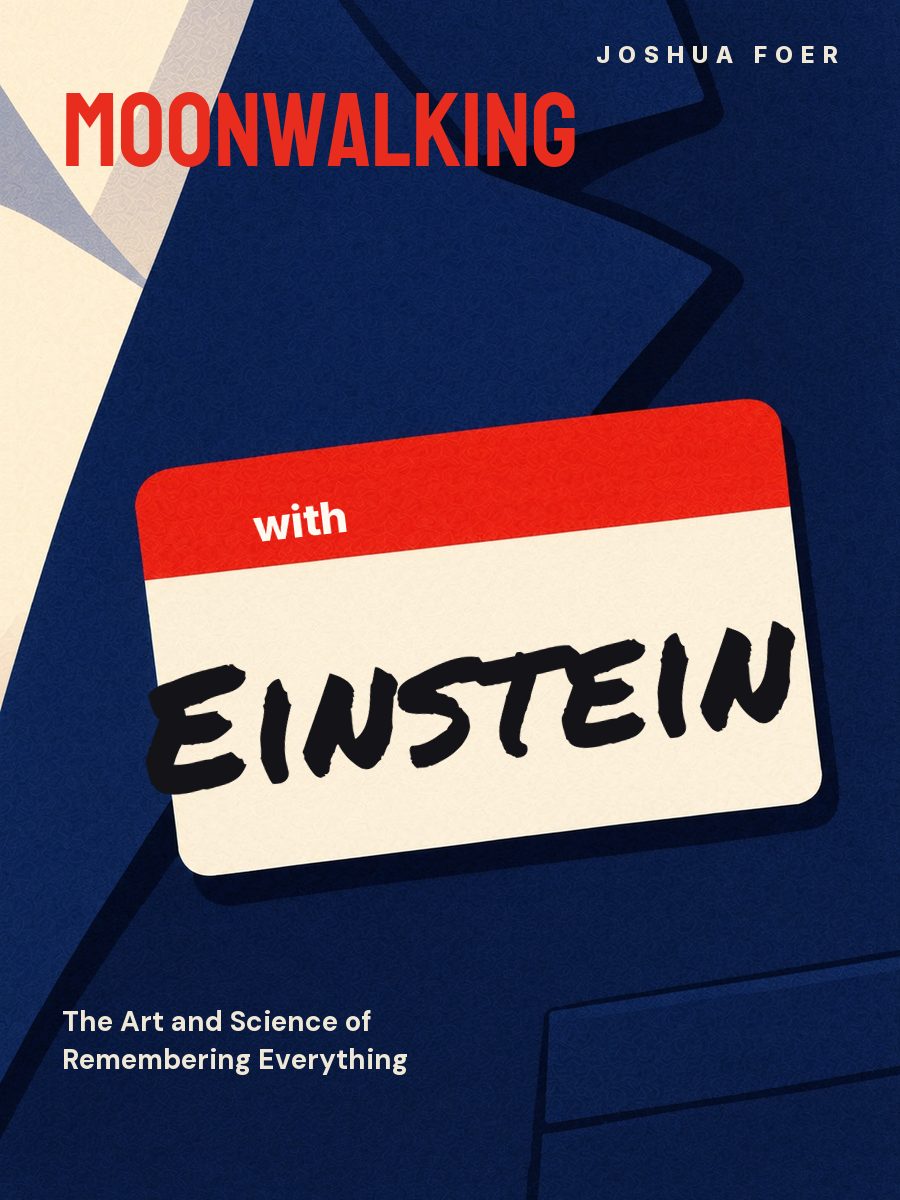
Moonwalking with Einstein: The Art and Science of Remembering Everything
A science journalist went to a memory contest to write a short piece and a year later won it. Joshua Foer trained with the mental athletes, studied a man who could not forget, met a man who could not remember, and asked psychologists what expertise really is. Foer's conclusion: memory can be trained like any other skill, and remembering begins with paying attention.
Who it is for
For anyone who reads a book and keeps only a fog of it a month later, and who suspects that a good memory is something you are either born with or not.
Remembering can only happen if you decide to take notice.
A reporter among the mental athletes
In 2005 the science journalist Joshua Foer went to the U.S. Memory Championship in New York for a short article. Instead of freaks of nature he found ordinary people memorizing a poem, a page of a thousand random digits and a shuffled deck of cards.
Ed Cooke, a young grand master from England, laughed at the idea that he was a savant. Photographic memory, he said, does not exist; every competitor had an average memory, used well. Their method was the memory palace, which legend credits to the Greek poet Simonides. After a banquet hall collapsed, he could show the victims' relatives where each guest had been sitting.
Foer, who kept losing his car keys, tested the claim on himself. A year later he sat in the final of the same contest. The book follows that year and the science behind it, and asks: why remember anything when paper, phones and search engines remember for us?
The man who could not forget
A Russian reporter known as S. never took notes at meetings. Scolded by his editor, he repeated the whole morning meeting word for word. From 1928 the neuropsychologist Luria studied him for thirty years and never found the limit of his memory.
S. was a synesthete: every word instantly became a picture, a colour or a taste. To keep a list in order, he placed the pictures along a street he knew and later walked it again. When he did lose a word, it was a slip of perception: he once missed an egg he had put against a white wall.
But S. could not forget. Abstract words and metaphors defeated him, and he never kept a steady job.
When Eleanor Maguire scanned top competitors from the World Memory Championship, their brains and test scores were normal. While memorizing, though, they used regions for visual memory and spatial navigation. They had taught themselves to remember like S.
About the author
Joshua Foer is an American science journalist who wrote for Slate, Discover and other publications. In 2006 he won the U.S. Memory Championship and set a national record in speed cards.
All books by this author: Joshua Foer
Moonwalking with Einstein: The Art and Science of Remembering Everything Quiz
Terms from the book
- Luria
- hippocampus
- Cicero
- Ericsson
- Matthews
- handicap
- Cooke: Ed Cooke, an English grand master of memory and Oxford graduate in psychology and philosophy, who became Foer's coach.
- photographic memory: The supposed ability to store a mental snapshot and recall it with perfect accuracy. Foer reports that there is no reliable evidence anyone has it.
- memory palace: An ancient technique also called the method of loci: images of what you want to remember are placed along a route through a place you know well.
- Simonides: Simonides of Ceos, a Greek poet of the fifth century B.C. whom legend credits with inventing the art of memory.
- synesthete: A person with synesthesia, a condition in which the senses are intertwined, so that a sound, for example, also has a colour or a taste.
- Maguire: Eleanor Maguire, neuroscientist at University College London who scanned the brains of top memory competitors.
- EP: The initials under which medical literature describes a retired lab technician from San Diego who lost his memory after a viral infection of the brain in 1992.
- Siffre: Michel Siffre, French scientist who studied time and living organisms; in 1962 he lived two months alone in a cave without a clock.
- elaborative encoding: The basic principle of memory techniques as Ed Cooke explains it: turning dull information into a vivid, unusual image that the mind holds easily.
- Rhetorica ad Herennium: An anonymous Latin textbook on rhetoric written about 86 to 82 B.C.; it holds the fullest surviving ancient description of memory techniques.
- chicken sexers: Specialists who determine the sex of newly hatched chicks.
- inning: A unit of play in baseball in which each team gets a turn to bat.
- OK plateau: Foer's name for the point at which a person decides they are good enough at something, switches to autopilot and stops improving.
- Fitts: Paul Fitts, American psychologist who, with Michael Posner, described three stages of learning a skill.
- Posner: Michael Posner, American psychologist, co-author with Paul Fitts of the three-stage description of skill learning.
- mammographers: Doctors who read mammograms, the X-ray images used to look for breast cancer.
Similar books
- My Morning Routine: How Successful People Start Every Day Inspired, Benjamin Spall, Michael Xander
- Outwitting the Devil: The Secret to Freedom and Success, Napoleon Hill
- Peak: Secrets from the New Science of Expertise, Anders Ericsson, Robert Pool
- The Power of Habit, Charles Duhigg
- Psycho-Cybernetics, Maxwell Maltz
- Quarterlife: The Search for Self in Early Adulthood, Satya Doyle Byock
- Range: Why Generalists Triumph in a Specialized World, David Epstein
- Rejection Proof: How I Beat Fear and Became Invincible Through 100 Days of Rejection, Jia Jiang
- Multipliers: How the Best Leaders Make Everyone Smarter, Liz Wiseman, Greg McKeown
- Psychology and Industrial Efficiency, Hugo Münsterberg