
The key ideas
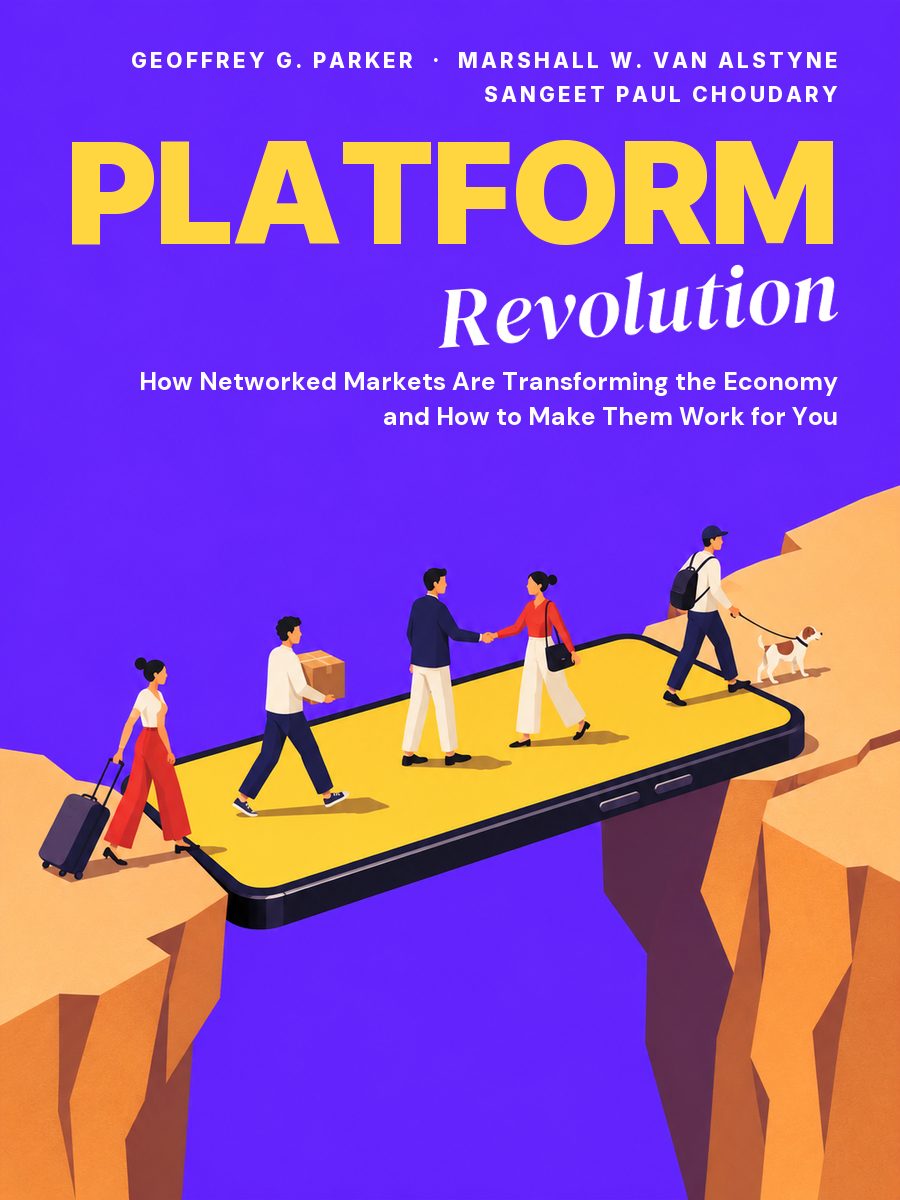
Platform Revolution: How Networked Markets Are Transforming the Economy and How to Make Them Work for You
A home rental service that does not own a single room is taking customers from hotel chains. Three platform researchers explain where such companies get their power and why it grows with the number of users. You will learn how such a marketplace is built, how it is launched when nobody is there yet, and which of its users it charges.
Who it is for
For people launching a service, a community or a marketplace where different people meet, and for anyone curious about the rules behind the apps we use every day.
In less than a decade, Airbnb has siphoned off a growing segment of customers from the traditional hospitality industry, all without owning a single hotel room of its own.
A hotel without a single room
In the fall of 2007 two young designers in San Francisco could not pay their rent. During a big conference, when the hotels were full, they offered attendees air mattresses in their own home. Three guests came, and the hosts made a thousand dollars. Out of this venture grew Airbnb, which a few years later was operating in 119 countries without owning a single hotel room.
Geoffrey Parker, Marshall Van Alstyne and Sangeet Choudary trace such stories to the difference between two ways a business can be built. A conventional company is like a pipeline: it makes a product itself and moves it down a chain to the buyer. A platform produces almost nothing. It connects those who create value with those who consume it and sets the rules for their meeting. In the authors' view, when a platform enters a market of such pipelines, it almost always wins.
From this comes the book's main idea. A platform grows thanks to people and things outside it, so the company turns inside out, as it were: it manages its own warehouses and staff less and arranges other people's meetings more. What follows is about where this power comes from, how a platform is built, how it is launched from scratch and what it makes money on.
Every new participant makes the service more valuable
In 2014 a well-known finance professor valued Uber at about $5.9 billion, even though investors had just valued the company at about $17 billion. He calculated the size of the taxi market and the share the company could capture. A venture capitalist who had invested in Uber replied that this calculation missed the main point: in five years the taxi market in San Francisco had grown roughly threefold.
The authors call this mechanism the network effect. The value of a service to each person grows with the number of other participants. More drivers mean shorter waits, and new passengers come. More passengers mean less idle time, so a driver earns just as much even at a low price, and the low price brings in still more people. In the factories of the last century, goods got cheaper as production grew, while platforms, in the authors' view, gain from growing demand.
Discounts and advertising also bring people in, but the authors set them apart from this mechanism. A discount disappears when the promotion ends, while the network effect keeps those who have already come.
But it is a mistake to think that more is always better. The network effect can also be negative. On the dating site OkCupid, according to its head, men messaged the most attractive women en masse. Those women grew tired of the flood and left, while hardly anyone replied to the men. The site began showing people matches who were about as attractive as they were, as judged by other users, and the number of replies grew. The book has a name for this kind of selection: curation. Without it, growth turns into noise.
About the author
Geoffrey Parker and Marshall Van Alstyne earned their doctorates at MIT and were among the first to describe the economics of two-sided markets. Sangeet Choudary led new ventures at Yahoo and Intuit and then began advising companies on platform strategy.
All books by this author: Geoffrey G. Parker, Marshall W. Van Alstyne, Sangeet Paul Choudary
Terms from the book
- PayPal
- eBay
- Uber
- venture capitalist
- curation
- Harvard
- friction
- Airbnb: A short-term home rental service: hosts rent out rooms and apartments to travelers, and the company takes a fee on every booking.
- pipeline: The authors' image for a business that creates a product or service itself and moves it step by step to the buyer.
- platform: In the book: a business that produces almost nothing itself but connects outside producers and consumers and sets the rules for how they interact.
- network effect: The key idea of the book: the value of a service to each user changes with the number of other users. It can be positive or negative.
- OkCupid: An American dating site that matches people based on their questionnaires and behavior.
- Fasal: An Indian service that told farmers the prices at nearby markets. Sangeet Choudary led its launch.
- core interaction: The authors' term: the main exchange on a platform, the one most people come for, such as a ride on Uber or a booking on Airbnb.
- value unit: The authors' term: what a producer posts on a platform, such as a listing, a video, a profile or a questionnaire.
- filter: In the book: a rule or algorithm by which a platform selects the right value units for a person, such as a search query or a feed.
- bot: A program that carries out actions online on its own, in place of a person.
- OpenTable: A service for booking restaurant tables.
- micromarket: An image from the book: a small, close circle of people who already interact with one another; such a circle is a convenient place to start a new platform.
- Meetup: A service through which people find interest groups and arrange to meet in person.
- Heiferman: Scott Heiferman, co-founder and head of Meetup.
Similar books
- Pre-Suasion: A Revolutionary Way to Influence and Persuade, Robert Cialdini
- Predictably Irrational: The Hidden Forces That Shape Our Decisions, Dan Ariely
- Principles: Life and Work, Ray Dalio
- The Principles of Scientific Management, Frederick Winslow Taylor
- Quit: The Power of Knowing When to Walk Away, Annie Duke
- Radical Candor, Kim Scott
- Reinventing Organizations, Frederic Laloux
- Remote: Office Not Required, Jason Fried, David Heinemeier Hansson
- Platonic: How the Science of Attachment Can Help You Make, and Keep, Friends, Marisa G. Franco
- The Power of Habit, Charles Duhigg