The key ideas
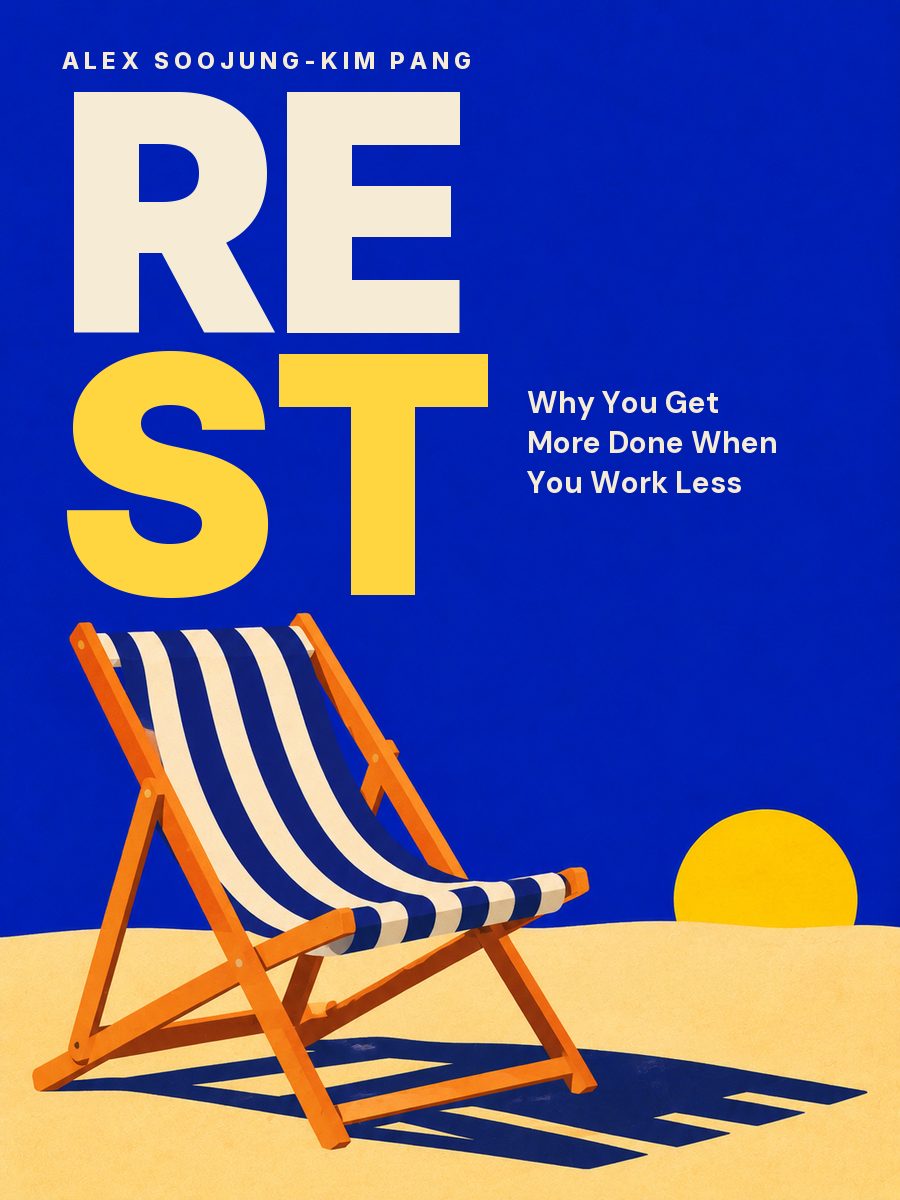
Rest: Why You Get More Done When You Work Less
Darwin did serious work for about four and a half hours a day and wrote nineteen books. Historian Alex Soojung-Kim Pang studies the days of scientists, writers and leaders and shows that their rest was not a prize for finished work but part of the work itself. Walks, naps, an unfinished sentence and a demanding hobby turn out to be tools that help the mind keep working.
Who it is for
For anyone who works long hours, feels guilty about every break, and still ends the day with the sense that nothing important got done.
When we stop and rest properly, we're not paying a tax on creativity. We're investing in it.
The scientist who would have been fired in a week
Charles Darwin was at his desk by eight. At half past nine he read his letters, at half past ten he returned to his experiments, and by noon he declared he had done a good day's work. Then came a long walk, lunch, a nap at three, another walk and a last stretch of work before dinner. On this routine he wrote nineteen books, On the Origin of Species among them.
Alex Soojung-Kim Pang, a historian of science from Silicon Valley, adds up the hours: three ninety-minute stretches a day. A company today would have fired Darwin within a week. Yet he was no idler: he counted every hour lost to illness.
Pang found the same pattern in the lives of dozens of scientists and writers. Work and rest, he concludes, are partners, not rivals. Rest is a skill, and often an active one. He calls his approach deliberate rest and argues that rest taken well is an investment in creative work, not a tax on it.
Four hours is a ceiling, not laziness
Henri Poincaré, one of the greatest mathematicians of the nineteenth century, did his hardest thinking from ten to noon and from five to seven in the evening. G. H. Hardy said that four hours of creative work a day is about the limit for a mathematician.
In the early 1950s, psychologists Raymond Van Zelst and Willard Kerr compared how many hours their colleagues spent at work with how many articles they published. Output peaked at ten to twenty hours a week in the office. Scientists who put in thirty-five hours were half as productive as those who put in twenty, and those working over sixty published least of all.
It is one old survey, but it fits the biographies: deep concentration runs out, and extra hours buy the look of work rather than results. So protect three or four hours for your hardest task, ideally early, and then truly stop. Mathematician John Littlewood put it bluntly: either work all out or rest completely. A tired afternoon of half-working gives neither.
About the author
Alex Soojung-Kim Pang is an American historian of science and technology from Silicon Valley, a former visiting researcher at Microsoft Research Cambridge and the author of The Distraction Addiction.
All books by this author: Alex Soojung-Kim Pang
Rest: Why You Get More Done When You Work Less Quiz
Terms from the book
- REM
- Darwin
- Poincaré
- Hardy
- Hemingway
- Pauling
- Schwartz
- Blitz
- Eisenhower
- Gallipoli
- deliberate rest: Pang's term, not a scientific one: rest chosen and practised as carefully as work, so that it restores energy and lets the mind keep working on problems.
- Van Zelst: Raymond Van Zelst, psychologist at the Illinois Institute of Technology who, with Willard Kerr, surveyed scientists' work habits in the early 1950s.
- Kerr: Willard Kerr, psychologist at the Illinois Institute of Technology, co-author of the survey comparing scientists' hours with the articles they published.
- Littlewood: John Edensor Littlewood (1885–1977), Cambridge mathematician and Hardy's long-time collaborator, known for always taking Sundays off.
- Oppezzo: Marily Oppezzo, Stanford psychologist who measured the effect of walking on creative thinking.
- Rubik: Ernő Rubik, Hungarian teacher of design, inventor of the Rubik's Cube.
- Tchaikovsky: Pyotr Ilyich Tchaikovsky (1840–1893), Russian composer who spent about two hours walking every afternoon.
- Churchill: Winston Churchill (1874–1965), British prime minister during the Second World War.
- Mednick: Sara Mednick, sleep researcher who did some of the first studies measuring the benefits of daytime naps.
- Sonnentag: Sabine Sonnentag, German researcher who has studied for about twenty years how people recover from work.
- detachment: In Sonnentag's research, the state in which work leaves your head completely during time off.
- deep play: A term from anthropology that Pang applies to serious hobbies: absorbing, demanding, personally meaningful activities that restore you.
Similar books
- Rising Strong: The Reckoning. The Rumble. The Revolution., Brené Brown
- Show Your Work!: 10 Ways to Share Your Creativity and Get Discovered, Austin Kleon
- The Six Pillars of Self-Esteem, Nathaniel Branden
- Self-Help, Samuel Smiles
- So Good They Can't Ignore You: Why Skills Trump Passion in the Quest for Work You Love, Cal Newport
- Sorry I’m Late, I Didn’t Want to Come: One Introvert’s Year of Saying Yes, Jessica Pan
- Stop Checking Your Likes, Susie Moore
- Switch: How to Change Things When Change Is Hard, Chip Heath, Dan Heath
- Rethinking Narcissism: The Bad and the Surprising Good in Wanting to Feel Special, Craig Malkin
- The Revenge of Power, Moisés Naím