
The key ideas
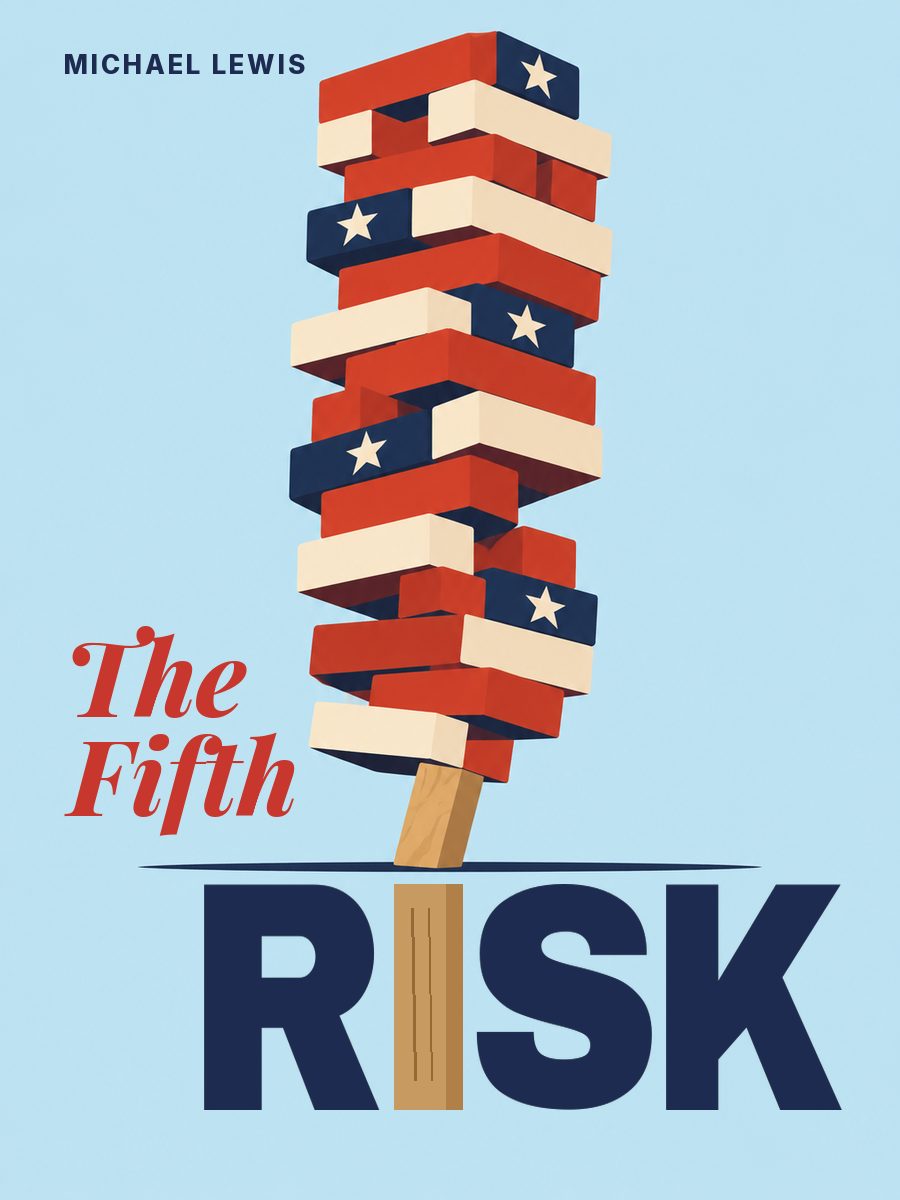
The Fifth Risk
After the 2016 election, staff at the US federal departments prepared briefings running to thousands of pages for the new team, but almost nobody came to hear them. Michael Lewis asked them himself: about nuclear waste, school lunches, weather forecasts and tornadoes. The result is a book about the risks the government keeps under control so quietly that nobody notices them.
Who it is for
For anyone curious about what the government actually does, and for everyone used to putting slow risks off until later.
The risk we should most fear is not the risk we easily imagine. It is the risk that we don’t.
Thirty empty desks
On November 9, 2016, the morning after the US presidential election, the Department of Energy cleared thirty desks and freed up thirty parking spaces. The staff had prepared binders of briefings, the same for either winner. Eight years earlier Barack Obama had sent more than thirty people here on the very first day. This time nobody came on the first day.
Journalist Michael Lewis decided to do what the new team hadn’t. He tracked down people who had just left the Departments of Energy, Agriculture and Commerce and asked them for a briefing of his own. His judgments of the Trump administration are harsh, and they are the author’s judgments. But the main character of the book is not a politician; it is the government itself, which most people barely notice.
Lewis’s idea is this: the government manages an enormous set of risks, from nuclear weapons to the weather forecast. The most dangerous of them are not loud disasters but slow, boring threats. And they are easiest to miss for someone who doesn’t want to know.
The scariest risk has a boring name
John MacWilliams left the bank Goldman Sachs and founded an investment firm. In 2013 the Secretary of Energy, the nuclear physicist Ernest Moniz, brought him into the department and later made him its first chief risk officer. MacWilliams found that about half of the budget went to the nuclear arsenal, and another quarter to cleaning up what was left over from making bombs.
He drew up a list of about a hundred and fifty risks, but the new team never heard him out. Lewis played the cocky newcomer and asked for the top five. MacWilliams named a nuclear weapons accident, North Korea, Iran and the power grid. Fifth he named project management.
What that means can be seen at Hanford, where plutonium was produced from 1943 to 1987, two-thirds of the entire American stockpile. Underground there sit 177 tanks of the most dangerous waste, and 67 of them have already leaked. The cleanup, by MacWilliams’s estimate, will take a century and cost a hundred billion dollars. Nobody wanted to look seriously at Hanford’s risks: not the contractors, not the officials, not the local residents who live off federal billions. Only the Indian tribes wanted to know the truth.
Lewis sees the fifth risk as the habit of responding to long-term threats with short-term solutions. It is a bomb with a long fuse: a postponed repair of a tunnel full of waste, an aging workforce, research that was never started. People, MacWilliams explains, easily imagine vivid disasters and barely notice quiet, systemic ones. In Lewis’s view, ignorance has its benefits: someone who wants a quick payoff finds it more convenient not to know its cost.
About the author
Michael Lewis is an American journalist who sold bonds at Salomon Brothers in the 1980s and is the author of Liar’s Poker, Moneyball and The Big Short.
All books by this author: Michael Lewis
Terms from the book
- Goldman Sachs
- Obama
- Tesla
- Myers
- Moore
- Sullivan
- Briefing: A short spoken or written rundown: what is happening, what decisions are waiting and what risks there are. In the book, this is the name for the materials the departments prepared for the new team.
- Trump: Donald Trump, the 45th president of the United States, elected in 2016. Lewis describes how his team took over the departments; the judgments in the book are the author’s.
- MacWilliams: John MacWilliams, a former investment banker and the first chief risk officer of the US Department of Energy, where he worked from 2013 to 2017. Lewis’s main source in the first part of the book.
- Moniz: Ernest Moniz, a nuclear physicist from the Massachusetts Institute of Technology and US Secretary of Energy from 2013 to 2017.
- Chief risk officer: The person who draws up a list of the things that could go wrong for an organization, estimates how likely they are and what they would cost, and makes sure someone is dealing with them.
- Hanford: A site in the east of Washington State where plutonium for nuclear weapons was produced from 1943 to 1987. Today it is the scene of the largest radioactive waste cleanup in the United States.
- Plutonium: A radioactive metal produced in nuclear reactors and used to make nuclear warheads.
- Zaidi: Ali Zaidi, a White House staffer under Obama; he was responsible for the budgets of several agencies and later served as the president’s energy adviser.
- Salerno: Lillian Salerno, an entrepreneur from Texas and inventor of a retractable syringe; she spent about five years in the rural development office of the US Department of Agriculture.
- Stier: Max Stier, founder of the Partnership for Public Service, an organization that works to improve the US civil service.
- Solyndra: An American solar panel maker that failed to repay a government loan and went bankrupt in 2011.
- Concannon: Kevin Concannon ran the nutrition programs of the US Department of Agriculture from 2009 to 2017, and before that the health services of several states.
- AccuWeather: A private American company that sells weather forecasts and advertising; founded in 1962.
- NOAA: The National Oceanic and Atmospheric Administration of the United States, part of the Department of Commerce. The National Weather Service reports to it.
- Patil: DJ Patil, a mathematician and data scientist, the first chief data scientist of the US government, under Obama.
- Joplin: A city in Missouri destroyed by a tornado on May 22, 2011.
- Klockow: Kim Klockow, a meteorologist who studies how people behave in dangerous weather; the first social scientist at NOAA.
- Elk City: A small town in western Oklahoma hit by a tornado on May 16, 2017.
- Risenhoover: Lonnie Risenhoover, emergency manager of Beckham County, Oklahoma, and a former firefighter.
Similar books
- Boomerang: Travels in the New Third World, Michael Lewis
- Going Infinite, Michael Lewis
- The Big Short: Inside the Doomsday Machine, Michael Lewis
- The Gift of Fear, Gavin de Becker
- The Good Enough Job: Reclaiming Life from Work, Simone Stolzoff
- The Hidden Life of Trees: What They Feel, How They Communicate: Discoveries from a Secret World, Peter Wohlleben
- The History of Jazz, Ted Gioia
- The Like Switch, Jack Schafer, Marvin Karlins
- The Five Archetypes. How to Understand Yourself and Get Along with Others, Carey Davidson
- The Flirting Bible: Your Ultimate Photo Guide to Reading Body Language, Getting Noticed, and Meeting More People Than You Ever Thought Possible, Fran Greene