
The key ideas
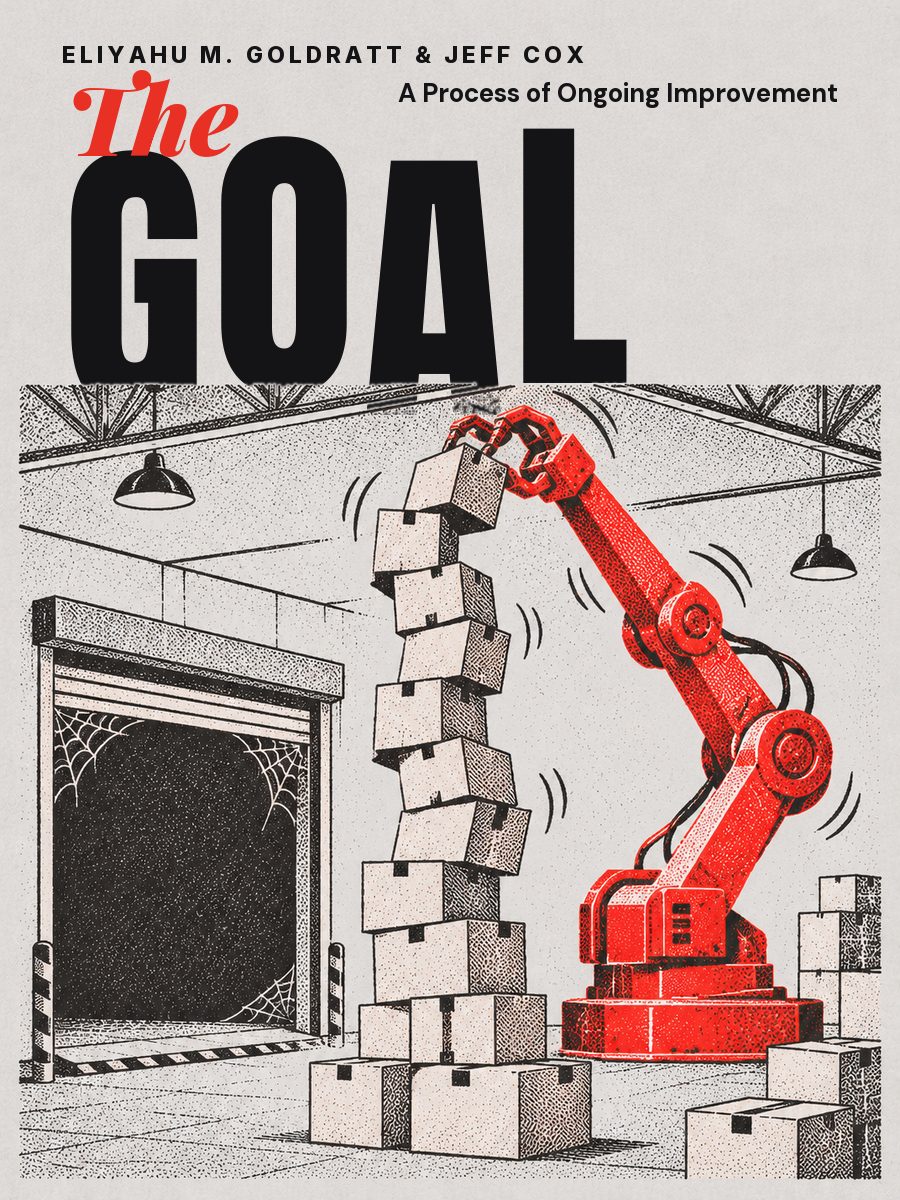
The Goal: A Process of Ongoing Improvement
A plant manager has three months to save his factory, and his robots, his efficiencies and his overtime only make things worse. A physicist he meets in an airport answers him with questions. Through a scout hike, a game with matches and a machine nobody can spare for an hour, Alex Rogo works out why a plant where everyone is busy loses money, and what he can do about it.
Who it is for
For anyone whose team is busy all day and still ships late. For managers judged by efficiency reports that never seem to match the money. For readers who would rather learn a way of thinking through a story than through a textbook.
A plant in which everyone is working all the time is very inefficient.
Three months and one question
At 7:30 in the morning Alex Rogo finds his boss's crimson Mercedes in his parking space. Bill Peach has had the whole plant chasing order 41427, seven weeks late. Before he leaves he gives Rogo three months: turn the plant around or it will be closed.
Two weeks earlier, in an airport lounge, Rogo had boasted to Jonah, a physicist he once studied under, that robots raised productivity in one department by thirty-six percent. Did the plant ship one more product a day, Jonah asked. Did inventories or expenses go down? Rogo could not answer yes to any of them. Then Jonah asked what the goal of the plant was and boarded his plane.
The Goal is a novel by Eliyahu M. Goldratt, written with Jeff Cox. Jonah answers with questions, so the reader works out the answers along with Rogo. What they work out later became known as the theory of constraints.
Money coming in, money stuck inside, money going out
Rogo skips Peach's meeting and looks down at his plant from a hill. Then he notices two warehouses holding twenty million dollars of finished goods, well made and unsold. The goal of a company, he decides, is to make money; everything else is a means.
Jonah gives him three measures. Throughput is the rate at which the system generates money through sales, not through production. Inventory is all the money invested in things it intends to sell. Operational expense is all the money spent turning inventory into throughput. Lou, the controller, sums it up: money coming in, money stuck inside, money going out. An action is productive only if it raises the first while lowering the other two.
The robots fail this test. When they ran at thirty percent efficiency, the plant released more material to keep them busy. Efficiency rose, parts piled up for orders that did not exist, and sales stayed flat.
About the author
Eliyahu M. Goldratt (1947–2011) was an Israeli physicist who became a management thinker and founded the theory of constraints. Jeff Cox, an American writer and the author of several business novels, wrote The Goal with him.
All books by this author: Eliyahu M. Goldratt, Jeff Cox
The Goal: A Process of Ongoing Improvement Quiz
Terms from the book
- Herbie
- bottleneck
- inertia
- Rogo: Alex Rogo, the novel's narrator: a 38-year-old manager of a UniCo plant in his home town of Bearington.
- Peach: Bill Peach, vice-president of the division and Rogo's boss, who gives him three months to turn the plant around.
- Jonah: A physicist Rogo once studied under. He works in what he calls the science of organizations and teaches Rogo by asking questions.
- theory of constraints: Goldratt's approach to managing any system through the few points that limit its performance. The name, often shortened to TOC, appears in the interviews added to the third edition.
- throughput: In Jonah's definition, the rate at which the system generates money through sales. Goods made but not sold are not throughput.
- inventory: In Jonah's definition, all the money the system has invested in things it intends to sell, from raw materials to machines and buildings.
- operational expense: In Jonah's definition, all the money the system spends to turn inventory into throughput, including wages, idle time and depreciation.
- Lou: The plant controller, two years from retirement, who becomes one of Rogo's strongest allies.
- dependent events: Jonah's term for steps that cannot start until the steps before them are done.
- statistical fluctuations: Jonah's term for the normal variation of quantities that cannot be predicted exactly, such as how long an operation takes.
- NCX-10: The plant's most expensive numerically controlled machine, the only one of its type, and one of its two bottlenecks.
- heat-treat: The department with two gas furnaces that soften metal parts over six to sixteen hours; the plant's second bottleneck.
- Donovan: Bob Donovan, the plant's production manager, a big, blunt man who has worked there for over twenty years.
- Zmegma: An old machine Bob Donovan fetches from another UniCo plant; with two other old machines it can do the NCX-10's work.
- Stacey: Stacey Potazenik, the plant's inventory control manager.
- Burnside: Bucky Burnside, president of one of UniCo's biggest customers.
Similar books
- The Hard Thing About Hard Things: Building a Business When There Are No Easy Answers, Ben Horowitz
- The Language of Trust, Michael Maslansky
- The Obstacle Is the Way: The Timeless Art of Turning Trials into Triumph, Ryan Holiday
- The Personal MBA: Master the Art of Business, Josh Kaufman
- The Power of Intuition, Gary Klein
- The Prince, Niccolò Machiavelli
- The Puzzler: One Man's Quest to Solve the Most Baffling Puzzles Ever, from Crosswords to Jigsaws to the Meaning of Life, A. J. Jacobs
- The Scout Mindset: Why Some People See Things Clearly and Others Don't, Julia Galef
- The Good Enough Job: Reclaiming Life from Work, Simone Stolzoff
- The Great Pretender: The Undercover Mission That Changed Our Understanding of Madness, Susannah Cahalan