
The key ideas
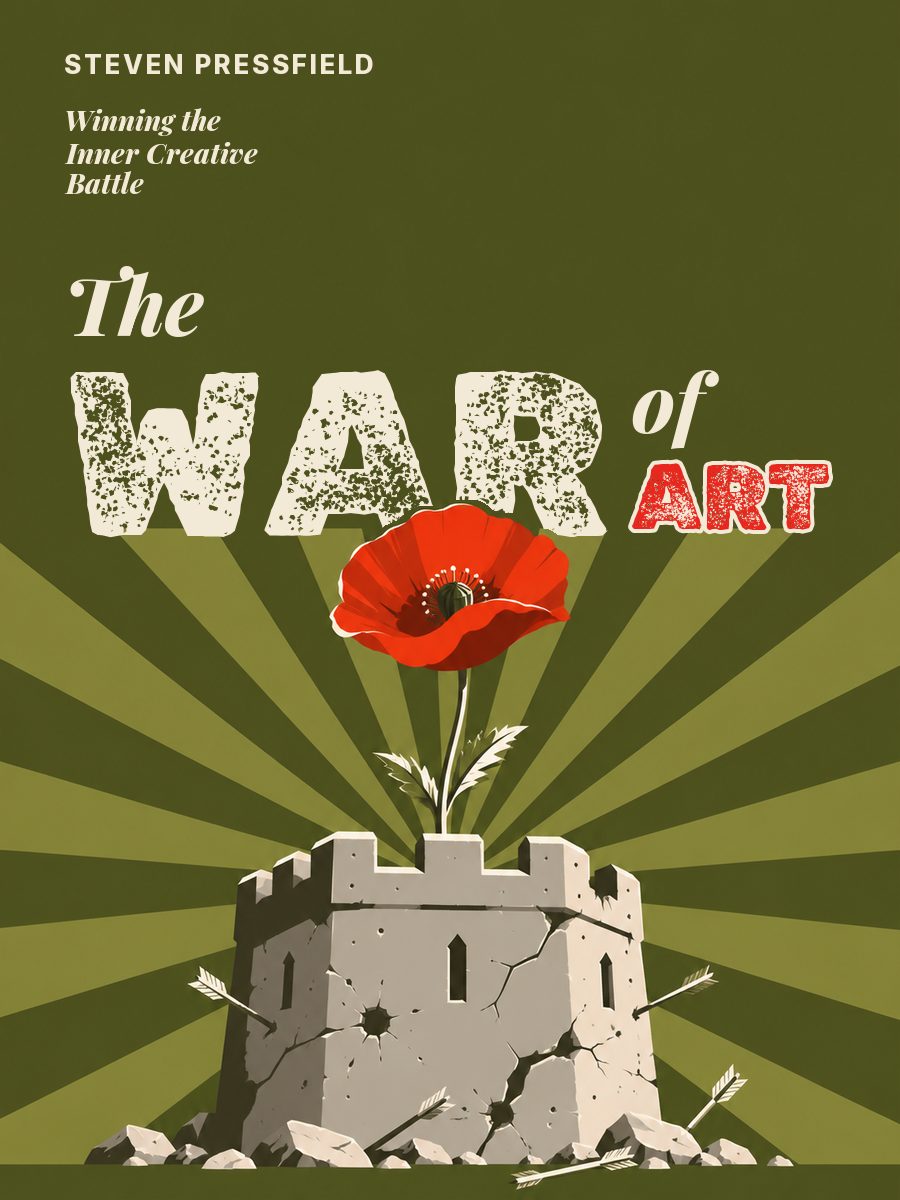
The War of Art: Winning the Inner Creative Battle
Why is it so hard to sit down to the work you dream of? Steven Pressfield ran from his writing desk for years and gave a name to the force that pulls you away from it: Resistance. He shows all its tricks and then explains how it is beaten: not by inspiration, but by the professional’s habit of sitting down to work every day.
Who it is for
For anyone who has spent years meaning to write a book, start their own business or get back to painting, but every time finds a reason to start on Monday.
It’s not the writing part that’s hard. What’s hard is sitting down to write.
Lucky boots and a blank page
Steven Pressfield starts his working day with a ritual. He puts on his lucky work boots, keeps his lucky charms close by and says a prayer out loud: the Invocation of the Muse from Homer’s Odyssey. Around ten-thirty he sits down at his desk and writes for four hours or so, until he starts making typos.
Only one thing matters: today he has overcome Resistance. That is Pressfield’s name for the force that stands in the way of anyone who has set out to do something important: a book, a business of their own, sport or study. In his words, most of us have two lives: the life we live, and the unlived life within us. Between the two stands Resistance.
The main thing he learned over years of failure sounds simple: “It’s not the writing part that’s hard. What’s hard is sitting down to write.” In The War of Art Pressfield shows the tricks of this enemy and explains how to fight it every day.
The voice that promises to start tomorrow
Resistance, according to Pressfield, rarely makes us say, “I’m never going to write my symphony.” Instead we say, “I am going to write my symphony; I’m just going to start tomorrow.” That is why the author considers procrastination its most common form: it is the easiest to justify. Worst of all, procrastination becomes a habit: we put off our lives all the way to the deathbed.
It seems that a spouse, a boss or the kids are what hold us back. The author insists that the enemy sits inside and argues like a clever lawyer. The insidious part is that many of its arguments are true. Say a man’s wife is eight months pregnant, his department is going through a changeover, and it makes sense to put off the dissertation. Pressfield answers with an example: Leo Tolstoy had thirteen children and wrote War and Peace.
Resistance worked the same way on this very book. The voice in his head told Pressfield that he was a novelist and that setting himself up to teach others was vain. What moved him was something else: he was so unhappy without this work that he finally sat down to it and at once felt better.
When you find a solid reason to put off something important, ask yourself who is talking. The reason may be true, but the conclusion “not today” still comes from Resistance.
About the author
Steven Pressfield is an American novelist and screenwriter, the author of novels about ancient Greece and of The Legend of Bagger Vance. Before his first published novel he served in the Marine Corps and drove a cab.
All books by this author: Steven Pressfield
The War of Art: Winning the Inner Creative Battle Quiz
Terms from the book
- Tolstoy
- Homer
- Resistance
- Variety
- hierarchy
- McKee
- hack
- Muse
- Lipton: James Lipton (1926–2020), American writer and host of the TV show Inside the Actors Studio, where he asked famous actors about their work.
- Fonda: Henry Fonda (1905–1982), American stage and film actor and Academy Award winner.
- Maugham: William Somerset Maugham (1874–1965), English novelist and playwright, author of Of Human Bondage and The Moon and Sixpence.
- professional: In the book this is not a profession but an attitude to the work: a person shows up to work every day, whatever they feel, and doesn’t wait for inspiration.
- Keppelman: Tony Keppelman, a friend of Pressfield’s who asked him, after his first film flopped, whether he was going to quit.
- territory: The author’s image: a pursuit or a place that restores your strength by itself, without anyone’s approval. For example, a workshop, a gym, an instrument.
- Wonder: Stevie Wonder, American singer, songwriter and pianist, blind since infancy.
- Schwarzenegger: Arnold Schwarzenegger, bodybuilder, actor and politician. In the book he is the example of a person for whom the gym became his territory.
- The Legend of Bagger Vance: Pressfield’s novel about golf, published in 1995. In 2000 it was made into a film with Will Smith and Matt Damon.
- Rink: Paul Rink, American writer, neighbor and mentor of the young Pressfield in Northern California. He gave him the text of the prayer to the Muse.
Similar books
- The Willpower Instinct, Kelly McGonigal
- Think Like a Rocket Scientist: The Workbook, Ozan Varol
- Thinking, Fast and Slow, Daniel Kahneman
- Tiny Habits: The Small Changes That Change Everything, BJ Fogg
- Transitions: Making Sense of Life's Changes, William Bridges
- Triggers: Creating Behavior That Lasts, Becoming the Person You Want to Be, Marshall Goldsmith, Mark Reiter
- Ultralearning: Master Hard Skills, Outsmart the Competition, and Accelerate Your Career, Scott H. Young
- Unfu*k Yourself: Get Out of Your Head and into Your Life, Gary John Bishop
- The Will to Believe, William James
- The Wisdom of Psychopaths: What Saints, Spies, and Serial Killers Can Teach Us About Success, Kevin Dutton