
The key ideas
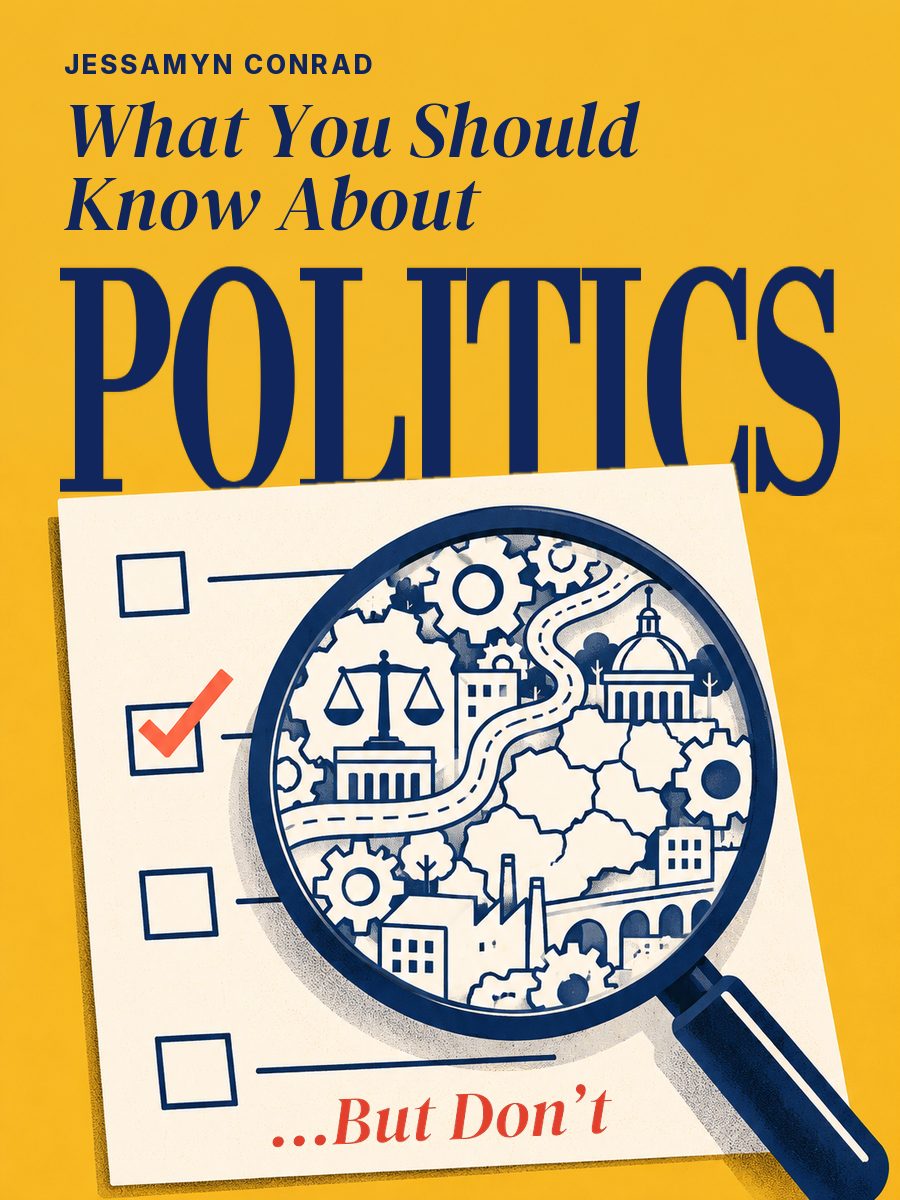
What You Should Know About Politics... But Don’t
Why can district boundaries decide an election instead of the votes? Jessamyn Conrad takes apart the main disputes of American politics so that each side gets to make its best case. The book teaches you to see the rules, words and numbers behind the slogans, and leaves the choice to the reader.
Who it is for
For anyone tired of the shouting in the news who wants to understand, without taking sides, what politicians are arguing about and what lies behind their slogans.
Always be suspicious of deficit numbers quoted by any politician who has an interest in making the economy look good.
The counting rules picked the winner
In the autumn of 2000 the outcome of the US presidential election depended on Florida. George W. Bush led Al Gore there by a few hundred votes. Then came the recount, arguments over poorly punched ballot cards and lawsuits, and it went on until the Supreme Court stopped the recount by a five-to-four decision. Later, independent reviews reached a strange conclusion. Under the counting rules the Bush campaign proposed, Gore would have won, and under Gore’s rules, Bush would have won.
Jessamyn Conrad grew up in a political family: by the time the book came out, her father had been a senator from North Dakota for more than twenty years. She herself is a historian, belongs to no party and calls herself a pragmatist. Her book came out in 2008 and was meant as an impartial guide to the disputes of American politics: who wants what and why. All the figures in it refer to that time.
Conrad’s idea is this: you can’t understand politics from slogans. You need to see how the rules work, what words a dispute is framed in and what arguments each side has. The book leaves it to the reader to decide who is right.
Representatives choose their voters
Conrad explains how district drawing works with an invented example. A state has five districts that elect representatives to Congress, and one big city, Electopolis. Its residents vote for the Urban party, and rural residents vote for the Rural party. If two districts are drawn entirely inside Electopolis, the score will be three to two in favor of the Rurals, and every seat will be safe for its party.
But now the Urbans win a majority in the state legislature and redraw the map. Electopolis is cut into four parts. Instead of two districts that vote 90 percent Urban, there are four that vote 55 percent Urban. The Rurals are left with one district into which all their supporters have been packed. This kind of redrawing of boundaries is called gerrymandering: the opponent’s supporters are either packed into one district or spread across many. Both parties use it. As Conrad concludes, this way representatives choose their voters, rather than voters choosing their representatives.
Redrawing boundaries is also blamed for nearly permanent incumbents: House members who run for reelection win about 98 times out of a hundred. And computerized redistricting based on detailed data about residents is blamed for there being fewer mixed districts and ever more uncompromising parties. There are reform proposals too, for example ranked voting, in which voters rank the candidates in order. But changing the law, the author notes, would be up to those who benefit from it.
About the author
Jessamyn Conrad is an American historian and the daughter of a senator from North Dakota. She belongs to no political party.
All books by this author: Jessamyn Conrad
What You Should Know About Politics... But Don’t Quiz
Terms from the book
- Bush
- Gore: Al Gore, vice president of the United States under Bill Clinton and the Democratic candidate in the 2000 election.
- North Dakota: A sparsely populated rural state in the northern United States, the author’s home state.
- Electopolis: An imaginary city from Conrad’s example, where the Urban and Rural parties divide up the districts. It is the author’s illustrative model, not a real place.
- Gerrymandering: Redrawing the boundaries of electoral districts to favor one party: the opponent’s supporters are either packed into one district or spread across several.
- Ranked voting: A way of voting in which voters rank the candidates in order, and votes for eliminated candidates pass to the ones the voter ranked next.
- Libertarians: Supporters of minimal government: low taxes and no government interference in the economy or private life.
- Socialized medicine: Health care provided entirely by the government. In American politics the phrase is used as an attack on the other side.
- Deficit: The amount by which a government’s spending in a year exceeds its revenue. It is covered by borrowing.
- Social Security: The US government pension system, created in 1935. It is funded by a tax on working people’s wages.
- Tariffs: Taxes on imported goods. They make imports more expensive and protect domestic producers from competition.
Similar books
- Why Nations Fail, Daron Acemoglu, James A. Robinson
- You’re Not Listening: What You’re Missing and Why It Matters, Kate Murphy
- 2084 and the AI Revolution: How Artificial Intelligence Informs Our Future, John C. Lennox
- A Conflict of Visions, Thomas Sowell
- A Frog under the Tongue: Jewish Folk Medicine in Eastern Europe, Marek Tuszewicki
- A Hacker's Mind: How the Powerful Bend Society's Rules, and How to Bend Them Back, Bruce Schneier
- A Life on Our Planet: My Witness Statement and a Vision for the Future, David Attenborough
- Behave: The Biology of Humans at Our Best and Worst, Robert M. Sapolsky
- When Genius Failed: The Rise and Fall of Long-Term Capital Management, Roger Lowenstein
- Wherever You Go, There You Are: Mindfulness Meditation in Everyday Life, Jon Kabat-Zinn