
The key ideas
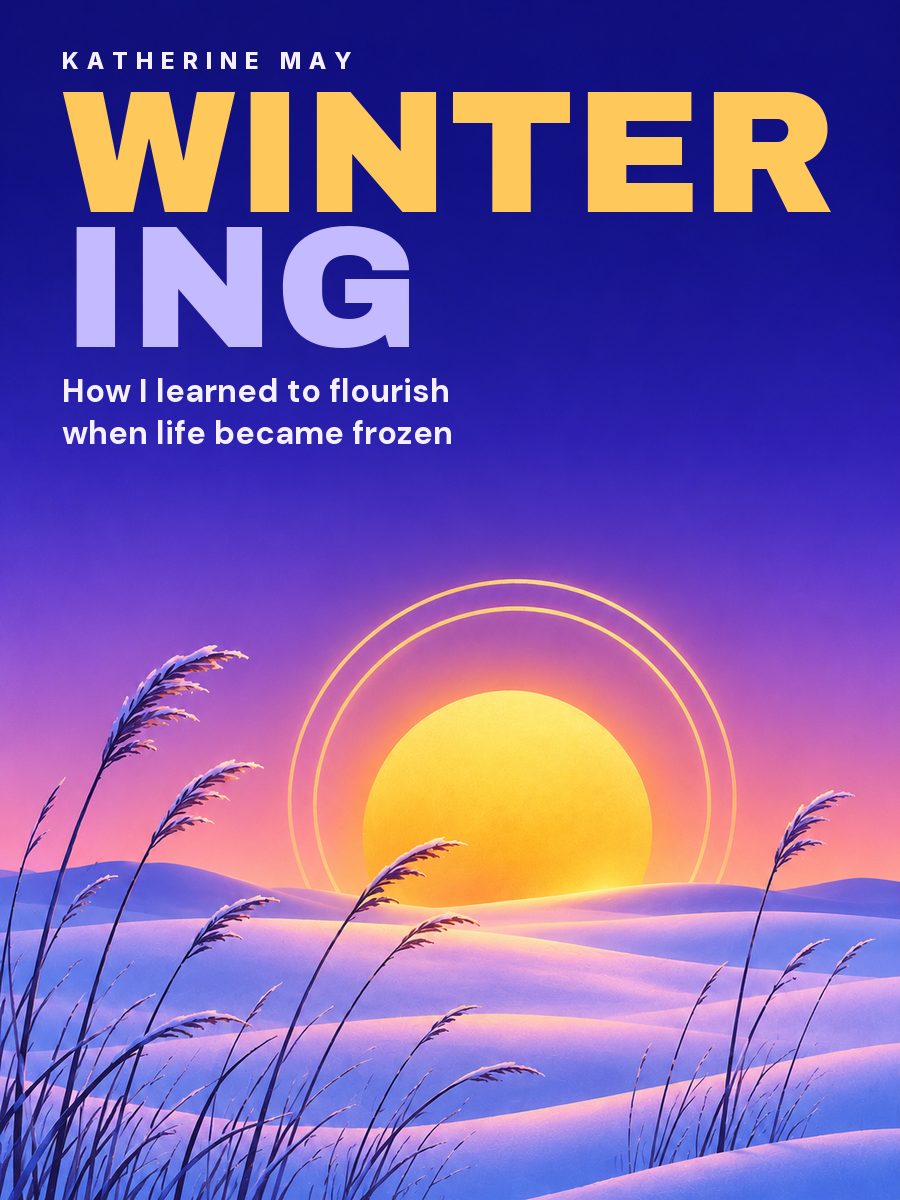
Wintering: The Power of Rest and Retreat in Difficult Times
In one autumn Katherine May's husband was rushed to hospital, her own health gave way and she left her job. Instead of pushing through, she spent the winter learning how trees, dormice, Finns and people who had survived their own crises get through the cold season. Her memoir turns that winter into a way of living through any hard stretch: get ready for it, rest, mark the turning of the year and pass on what you learn.
Who it is for
For anyone going through a stretch when life has stalled through illness, loss, burnout or a change they did not choose, and who is tired of being told to keep going as if nothing were wrong.
We may never choose to winter, but we can choose how.
Some winters begin in the sun
A week before her fortieth birthday, Katherine May was celebrating on a sunny beach in Folkestone. That night her husband was in hospital, and the next day his appendix burst. She had just handed in her notice at the university. Within weeks she was signed off sick with a pain no one could explain, and by December her six-year-old son was too anxious to go to school.
May, a British writer, calls a season like this wintering: a fallow time when illness, grief, failure or a change you did not choose cuts you off from ordinary life. Her book follows one such winter.
Her starting point is unwelcome. Everybody winters, often more than once, yet we hide it as a private failure. We cannot choose whether winter comes, May argues, only how we live through it.
Get ready for winter instead of pretending it is still summer
May's Finnish friend Hanne Mällinen-Scott starts preparing for winter in July. In Finland, repairs are finished before the snow, firewood is stacked, winter tyres go on, and the freezer fills with baking for guests. Her mother's word for it is talvitelat, roughly being stowed away for winter. You do not throw a jumper over summer clothes, Hanne says; you need a different wardrobe.
Trees do the same. As the days shorten they stop making food, because growth costs too much without sunlight. Through abscission they drop their leaves and seal the scars within hours. It looks like death, but it is a withdrawal to save what matters.
May tried this herself. She stopped rushing and kept her hands busy with small things: autumn stews, baking, candles, her son's colouring pencils. She wanted to lay down a bed of straw before the worst came. The English mistake, as Hanne sees it, is to go on dressing for summer as if nothing had changed.
About the author
Katherine May is a British writer who lives by the sea in Whitstable, Kent. Her earlier memoir, The Electricity of Every Living Thing, follows a long walk she took in the year she came to terms with being autistic.
All books by this author: Katherine May
Wintering: The Power of Rest and Retreat in Difficult Times Quiz
Terms from the book
- prolactin
- wintering: Katherine May's image, not a medical term: a fallow stretch of life when illness, loss, failure or change cuts a person off from ordinary life for a while.
- talvitelat: A Finnish word that May's friend translates roughly as being stowed away for winter. Her family used it for the day summer clothes were put away and winter ones brought out.
- Mällinen-Scott: Hanne Mällinen-Scott, a Finnish friend of the author who grew up in Liminka, where nearly half the year is spent below zero.
- abscission: The process by which a tree sheds its leaves: a layer of cells between leaf and branch weakens, cuts off the water supply, and the tree then seals the scar.
- Ekirch: A. Roger Ekirch, an American historian. In his book At Day's Close he argues that before the industrial revolution people often slept in two parts with a waking spell between them.
- Wehr: Thomas Wehr, an American sleep researcher. In 1996 he and colleagues studied how people sleep when kept without artificial light for fourteen hours a night.
- Sankta Lucia: Saint Lucy in Swedish. Her feast in mid-December is marked by a procession of girls in white, led by one wearing a crown of candles.
- solstice: The shortest or the longest day of the year. After the winter solstice, around 21 or 22 December in the northern hemisphere, the days begin to lengthen.
- Stonehenge: A prehistoric ring of standing stones in Wiltshire, England, built roughly four to five thousand years ago and aligned with the midsummer sunrise and the midwinter sunset.
- Carr-Gomm: Philip Carr-Gomm, the leader of the Order of Bards, Ovates and Druids, a modern British Druid organisation, and author of the book Druid Mysteries.
- Druid: In the modern sense, a follower of a present-day nature religion inspired by the priests of the ancient Celts. Little is known about the original Druids.
- Wheel of the Year: The cycle of eight seasonal festivals kept by modern Druids and other pagan groups: the two solstices, the two equinoxes and four farming festivals between them.
- Goldsmith: Shelly Goldsmith, a British textile artist and a friend of the author, whose work with old children's clothes has been shown in galleries around the world.
- meningitis: An inflammation of the membranes around the brain and spinal cord. The bacterial form can be life-threatening.
Similar books
- Younger Next Year, Chris Crowley, Henry Lodge
- Ageless: The New Science of Getting Older Without Getting Old, Andrew Steele
- An Unquiet Mind, Kay Redfield Jamison
- Being You, Anil Seth
- The Blue Zones, Dan Buettner
- The Body Keeps the Score, Bessel van der Kolk
- Brain Lock, Jeffrey M. Schwartz, Beverly Beyette
- Breath: The New Science of a Lost Art, James Nestor
- Women Who Love Too Much, Robin Norwood
- Words That Change Minds, Shelle Rose Charvet