The key ideas
What You're (Not) Going to Die Of
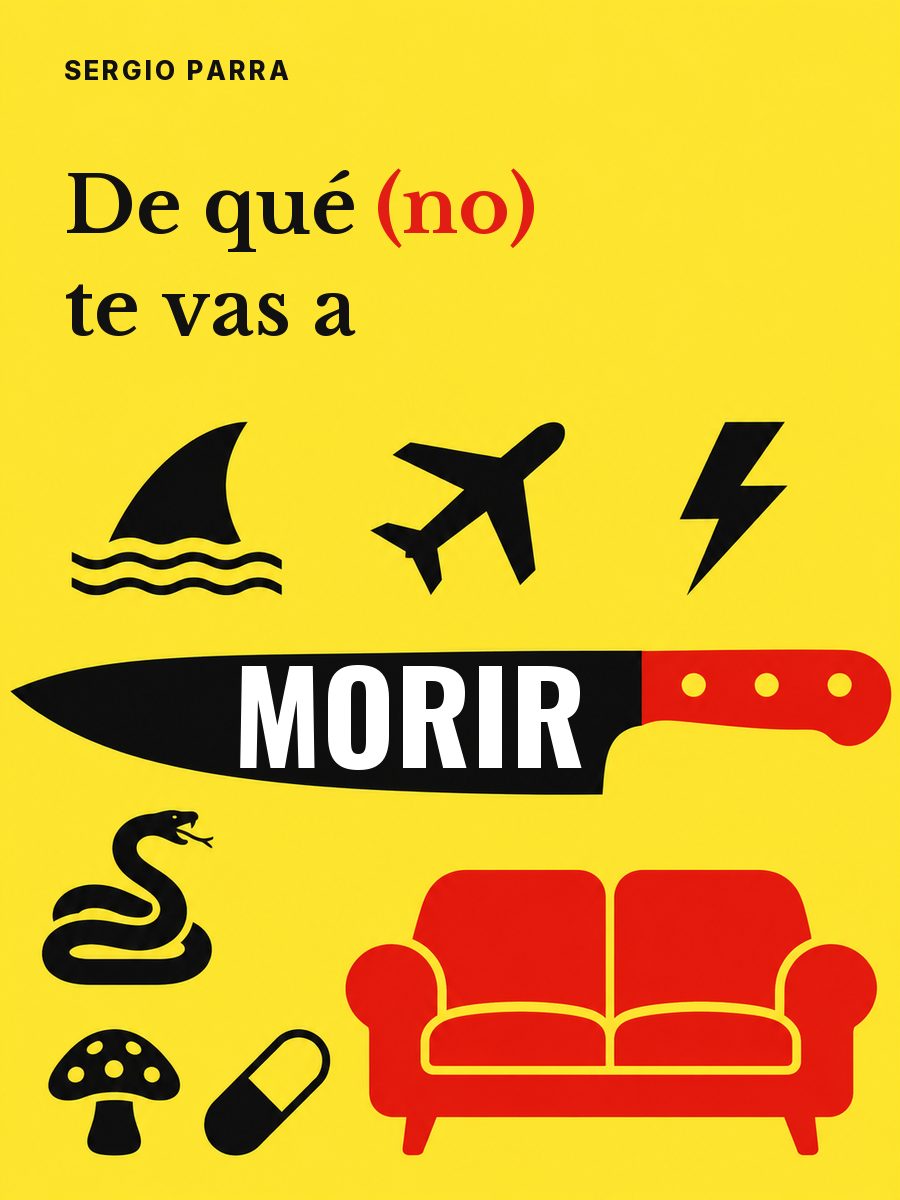
We are afraid of sharks, terror attacks and plane crashes, yet we calmly spend the evening on the couch. Spanish science writer Sergio Parra compares loud fears with the quiet dangers that take more lives. The book teaches you to read the numbers behind a risk and to point your fear where it is really needed.
Who it is for
For those who are frightened by news of terror attacks, plane crashes and serial killers, while everyday risks seem like nothing. And for anyone who wants to understand the numbers, not just feel the fear.
Progress can only be seen by looking back, but a crisis can be watched live twenty-four hours a day.
A minute of free fall
A plane from Barcelona to Santiago was flying over the Cantabrian mountains when it suddenly dropped: in one minute it lost 1,200 meters of altitude. Among the passengers was twelve-year-old Ignacio Crespo, today a doctor and science communicator. He later learned that it was clear-air turbulence, rare and usually not deadly. But in that minute, numbers meant nothing.
Crespo wrote the foreword to this book by Sergio Parra, a Spanish writer and science communicator. Parra starts with a simple fact: according to the classification of the WHO, the World Health Organization, there are more than 8,000 causes we can die from. Fearing them all equally is impossible. So we choose what to fear based on the news and on gut feeling, not on statistics.
Each chapter of the book puts a loud fear next to a quiet danger that takes more lives. The goal isn't to stop being afraid, because fear helps us survive. Fear is better aimed where the risk is real.
The amygdala can't count
Deep in the brain sits the amygdala, a small structure Parra compares to a fear switch. It worked well when a snake moved in the grass and the response had to be instant. But most modern risks act slowly and unnoticed, while the amygdala responds to the vivid and the sudden.
That is why a disaster in which hundreds of people die at once shocks us, while daily deaths from heart disease go unnoticed. The worst air disaster in history happened on Tenerife in 1977, and hundreds of people died in it. By the author's count, heart disease takes about as many lives in the US every eight hours, day after day.
The news makes the imbalance worse. According to Our World in Data for 2016, heart disease accounted for about a third of deaths in the US but only 2 to 3% of news stories. Violent deaths took up more than two thirds of the coverage in The New York Times and The Guardian, although they accounted for less than 3% of deaths. Sociologist Peter Sandman summed this up in a formula: risk equals hazard plus outrage.
Parra doesn't see journalists as villains. We are the ones demanding drama, and the media live on attention. So checking the scale is up to you.
About the author
Sergio Parra was born in Barcelona in 1978. He is a writer, literary critic and science communicator, the author of books on genetics and artificial intelligence, and he runs a YouTube channel about critical thinking.
All books by this author: Sergio Parra
What You're (Not) Going to Die Of Quiz
Terms from the book
- Mueller
- amygdala
- Howard
- Burnett
- Discounting
- Black
- Holt-Lunstad
- Cacioppo
- Crespo: Ignacio Crespo, a Spanish doctor and science communicator. He wrote the foreword to the book and in it described a terrifying flight he lived through as a child.
- Turbulence: Sudden shifts in air currents that make a plane shake. Clear-air turbulence happens in cloudless weather, which is why it is hard to predict.
- WHO: The World Health Organization, the UN agency for health. It maintains the international classification of diseases and causes of death.
- Tenerife: An island in the Canary Islands, Spain. In 1977 two planes collided at its airport: the deadliest air disaster in history.
- Our World in Data: An online publication based at the University of Oxford that collects statistics about the world and presents them visually. It was founded by economist Max Roser.
- Sandman: Peter Sandman, an American risk communication expert. He came up with the formula “risk equals hazard plus outrage”.
- Camp Nou: FC Barcelona's football stadium, one of the largest in Europe. According to the book, it has 99,354 seats.
- Yates: Kit Yates, a British mathematician at the University of Bath and the author of a book on how numbers deceive us in everyday life.
- Micromort: A unit of risk: a one-in-a-million chance of dying. It helps compare how dangerous different activities are.
- Gigerenzer: Gerd Gigerenzer, a German psychologist who studies how people understand risk and make decisions.
- Jetter: Michael Jetter, a researcher at the University of Western Australia. He studied how press coverage of terror attacks is linked to new attacks.
- Lancet: The Lancet, one of the oldest and most influential medical journals in the world, published in the UK since 1823.
Similar books
- Designing the Future, Jacque Fresco
- Difficult Conversations: How to Discuss What Matters Most, Douglas Stone, Bruce Patton, Sheila Heen
- Dollars and Sex: How Economics Influences Sex and Love, Marina Adshade
- Everybody Lies: Big Data, New Data, and What the Internet Can Tell Us About Who We Really Are, Seth Stephens-Davidowitz
- Factfulness, Hans Rosling
- First Women: The Grace and Power of America’s Modern First Ladies, Kate Andersen Brower
- Freakonomics, Steven D. Levitt and Stephen J. Dubner
- The Psychopathology of Everyday Life, Sigmund Freud
- Death and Its Mystery: Before Death, Camille Flammarion
- Death by Meeting: A Leadership Fable...About Solving the Most Painful Problem in Business, Patrick Lencioni