
The key ideas
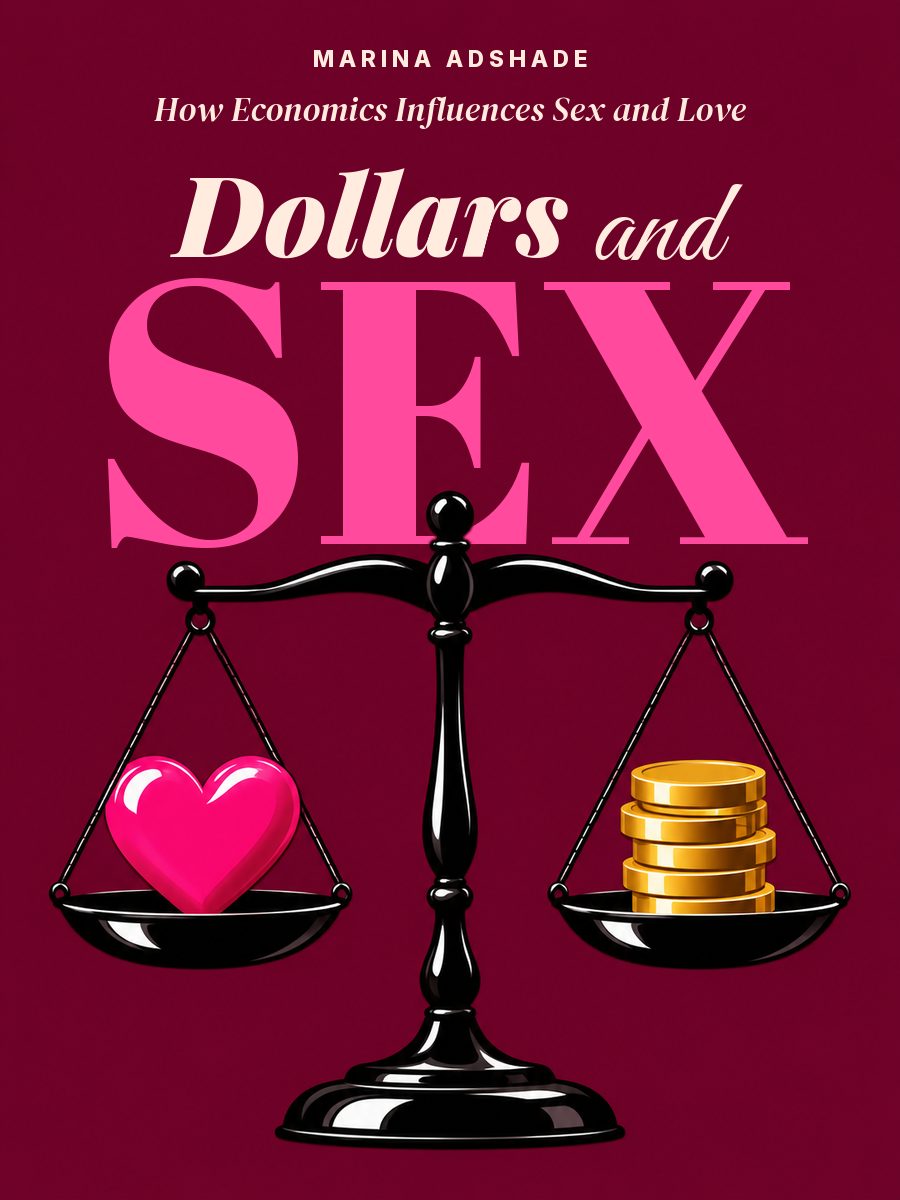
Dollars and Sex: How Economics Influences Sex and Love
Why does a university where women outnumber men see fewer ordinary dates? Economist Marina Adshade looks at love, sex and marriage as a market with its own prices, risks and bargaining. The result is a sober and unexpected view of how money, education and inequality shape the most personal decisions.
Who it is for
For people looking for a partner or living in a marriage, and for anyone curious why people choose each other the way they do.
Many of the people in your life who have made you happy, including possibly the person you are with right now, wouldn't pass muster based on a “must have” list that was searchable online.
Casanova's lemons at an economists' lunch
It is 2003, at a lunchtime seminar for economists. An eminent macroeconomist suddenly announces that Casanova used lemons as contraceptives. It sounds like a joke, but the point is serious: the sexual freedom of the twentieth century, he says, is explained by economics. Every evening millions of people decide whether to have sex, and new technologies have changed the price of that decision.
Marina Adshade, a Canadian economist, taught a university course called Economics of Sex and Love, and this book grew out of it. Her main idea: almost any choice in love and sex makes more sense if you look at it as a market. Everyone in this market has their own price, and decisions depend on risks and benefits.
The author makes two caveats right away. The data describe people on average, not you personally. And she does not judge what is good and what is bad: she is interested in how people behave, not in how they ought to behave.
When there is nothing to lose, risk looks cheap
An economist weighs risk simply: the probability of trouble multiplied by its price. Adshade's hypothetical example: in 1930 a woman who has sex without protection becomes pregnant with a probability of 85 percent. A child outside marriage costs a woman her chance of a well-off husband, worth, say, $50,000 of future income. The expected costs come to $42,500.
Jane's story shows the second part of the formula, the size of the loss, very clearly. At seventeen she left home and spent a year among poor women with no education. They readily entered into casual relationships, and morals had nothing to do with it. They did not expect a good job or a well-off husband, so an early pregnancy took little away from them: they had almost nothing to lose.
The same shows up among teenagers. Economist Benjamin Cowan found that when the local college costs $1,000 less, seventeen-year-old American high school students have 26 percent fewer sexual partners. They do not even have to enroll: it is enough to believe that they could.
It is commonly assumed that people become poor because of a disorderly life. Adshade believes the link runs the other way: for someone with no hope for the future, risk is cheaper.
About the author
Marina Adshade is a Canadian economist who teaches at the Vancouver School of Economics at the University of British Columbia. Her university course, Economics of Sex and Love, became the basis for this book.
All books by this author: Marina Adshade
Dollars and Sex: How Economics Influences Sex and Love Quiz
Terms from the book
- Cowan
- Sarah
- Jordan
- Alex
- Comparative advantage
- John
- Casanova: Giacomo Casanova (1725-1798), the famous seducer.
- Expected costs: An economic idea: the probability of a bad outcome multiplied by its price. This is how Adshade weighs the risk in decisions about sex and marriage.
- Jane: The heroine of a story that runs through the book. Adshade writes that the stories in the book are true to some degree, but the names have been changed.
- Regnerus: Mark Regnerus, a sociologist. With Jeremy Uecker he studied the sexual behavior of students at different U.S. colleges.
- Uecker: Jeremy Uecker, a sociologist, co-author of the study of students and the sex ratio on campuses.
- McIntosh: William McIntosh, a researcher. His group studied how choosy people of different ages are about a partner.
- Macaron: A French almond pastry made of two round halves with a filling.
- Thick market: An economic term: a market with many buyers and sellers, where it is easier to strike a deal. A thin market, by contrast, has few participants.
- Hellerstein: Judith Hellerstein, a researcher. With Melinda Morrill she studied the link between unemployment and divorce.
- Morrill: Melinda Morrill, co-author of the study of unemployment and divorce.
- Bargaining power: An economists' term: how often a person gets their way in a dispute with a partner. It depends on how well off they would be outside the relationship.
Similar books
- Everybody Lies: Big Data, New Data, and What the Internet Can Tell Us About Who We Really Are, Seth Stephens-Davidowitz
- Factfulness, Hans Rosling
- First Women: The Grace and Power of America’s Modern First Ladies, Kate Andersen Brower
- Freakonomics, Steven D. Levitt and Stephen J. Dubner
- The Psychopathology of Everyday Life, Sigmund Freud
- Games People Play, Eric Berne
- God Is Not One, Stephen Prothero
- Good for a Girl: A Woman Running in a Man's World, Lauren Fleshman
- Don't Shoot the Dog! The New Art of Teaching and Training, Karen Pryor
- Don't Sweat the Small Stuff... and It's All Small Stuff, Richard Carlson