The key ideas
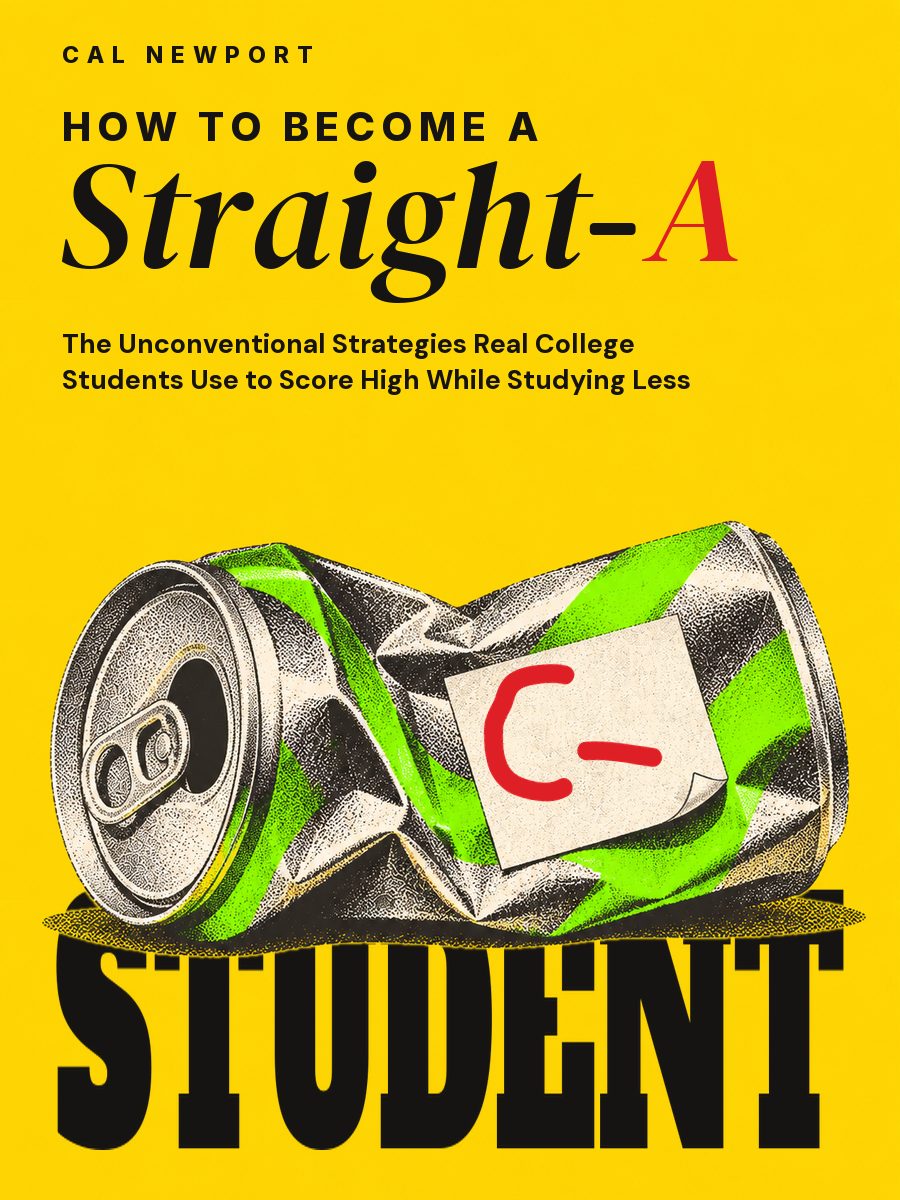
How to Become a Straight-A Student: The Unconventional Strategies Real College Students Use to Score High While Studying Less
Newport expected the thirty best students in his year to be grinds, and found people he knew from parties. He asked them, and then straight-A students across the country, how they actually study. Their answers add up to a system: a plan that takes five minutes a day, notes that capture the big ideas, an exam review with a clear finish and a paper written in separate stages.
Who it is for
For students who spend whole evenings in the library and still feel behind. For anyone taking a course, preparing for an exam or writing a long piece of work while also having a job and a life. For readers who suspect that more hours are not the answer.
Smart students understand that if you're studying hard, then you've done something wrong.
Thirty top students who were not grinds
In his final winter at Dartmouth, Cal Newport went to the ceremony admitting him and about thirty classmates to Phi Beta Kappa, the honor society for the highest grades in a class of over a thousand. He expected serious nerds. Instead he kept meeting people he knew from parties and clubs: magazine editors, fraternity members, environmental activists.
Newport had rebuilt his own study habits by trial and error: in his last three years he earned thirty-five As and one A-, while studying less and less. Afterwards, he surveyed his fellow members, then straight-A students at other colleges, discarding anyone who simply studied a huge amount.
The book is built from those interviews, not from laboratory research. Its claim is that studying is a skill, like basketball: practice an underhand shot twice as long and you still score less than someone who has learned the jump shot.
Three focused hours can do the work of a whole Sunday
A student carries three meals, a blanket and a six-pack of Red Bull into the study lounge for an all-day paper marathon. Another flips through chemistry notes on the couch with the TV on. One of Newport's interviewees called this pseudo-work. It looks and feels like effort, but focus is so low that little gets done.
Newport sums it up in a formula: work accomplished equals time spent multiplied by intensity of focus. If a test needs ten hours at an intensity of three out of ten, the same work fits into three one-hour bursts at full intensity, after breakfast, lunch and dinner.
The interviewees kept intensity high in three ways. They worked early, before dinner, often between classes, because an evening holds less time than it seems, more distractions and less energy. They studied in isolated spots, never in bed or in the dorm. And they worked about an hour at a time, then took a short break on something unrelated.
About the author
Cal Newport is a professor of computer science at Georgetown University and the author of Deep Work and So Good They Can't Ignore You. He conceived this book in his final year at Dartmouth College.
All books by this author: Cal Newport
Terms from the book
- Dartmouth
- intensity
- time budget
- Phi Beta Kappa: The oldest academic honor society in the United States. Students are elected to it for very high grades; in Newport's year it took about thirty students from a class of over a thousand.
- pseudo-work: A term one of Newport's interviewees used: long hours that look and feel like hard study but are done with so little focus that little gets done.
- time slot: In Newport's daily plan, the specific stretch of time written next to each task, so that the plan shows how much of the day is really free.
- work progress journal: A cheap notebook in which you write the day's main tasks each morning and, each evening, which were done and why the rest were not. Newport uses it during unusually busy periods.
- question, evidence, conclusion: Newport's note format for lectures and readings in non-technical subjects: every point is tied to the question it answers and the conclusion it supports.
- favored source: Newport's name for the textbook or course reader that appears on the reading list for almost every class. It is always read; other readings are chosen by importance.
- mega-problem set: Newport's name for a study pile in technical courses: a graded problem set with extra sample problems from the lecture notes and a question asking you to explain the general method.
- quiz-and-recall: Newport's review method: answer questions from your notes out loud or in writing without looking, tick the ones that gave trouble and repeat only those until a round adds no ticks.
- academic disaster insurance: Newport's name for clearing up, during the term, every point you did not understand, so that no exam question finds a topic you have never grasped.
- thesis: A specific argument that a paper sets out to prove. Newport separates it from a topic, which only names a subject or an observation.
- Faulkner: William Faulkner (1897-1962), an American novelist and Nobel Prize winner. Newport uses his early work as a made-up example of a paper topic.
- modernists: Writers of the early twentieth century, such as Joyce and Woolf, who broke with traditional forms of the novel.
- bibliography: The list of books and articles an author cites. Newport uses it to move from a general book to narrower sources.
- topic-level outline: Newport's plan for a paper: a list of the self-contained points in the order they will appear, with quotes from the sources typed under each, but no sentence-by-sentence script.
Similar books
- So Good They Can't Ignore You: Why Skills Trump Passion in the Quest for Work You Love, Cal Newport
- Deep Work: Rules for Focused Success in a Distracted World, Cal Newport
- Digital Minimalism, Cal Newport
- How to Live on 24 Hours a Day, Arnold Bennett
- How to Take Smart Notes: One Simple Technique to Boost Writing, Learning and Thinking, Sönke Ahrens
- How to Win Friends and Influence People, Dale Carnegie
- How We Learn: The Surprising Truth About When, Where, and Why It Happens, Benedict Carey
- Hyperfocus. How to Manage Your Attention in a World of Distraction, Chris Bailey
- How to Decide: Simple Tools for Making Better Choices, Annie Duke
- How to Do Nothing: Resisting the Attention Economy, Jenny Odell