
The key ideas
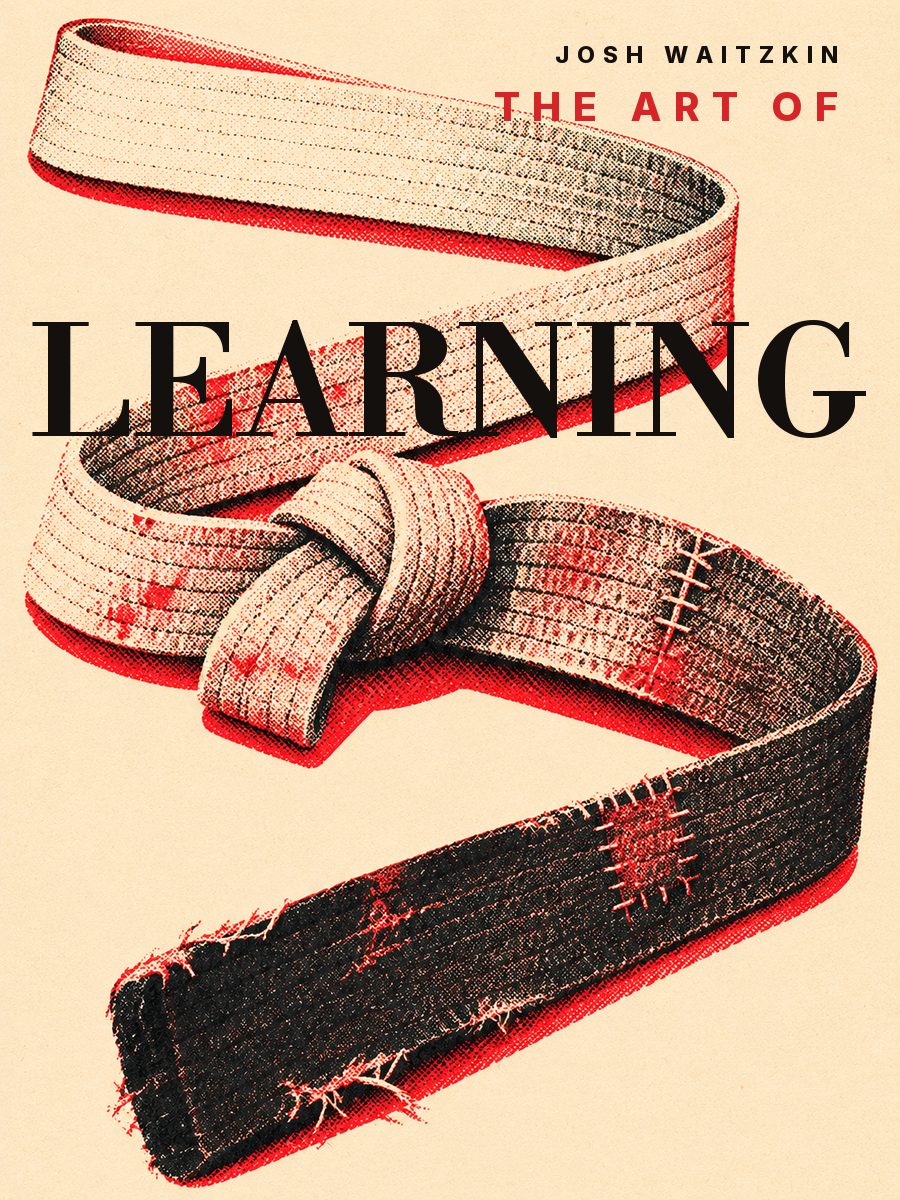
The Art of Learning: A Journey in the Pursuit of Excellence
A chess prodigy whose childhood became the film Searching for Bobby Fischer lost his love for the game and went on to become a world champion in Tai Chi Push Hands. Josh Waitzkin shows what his two careers had in common: a way of learning that starts very small, feeds on defeats and holds up under pressure.
Who it is for
For anyone learning a hard skill, from a language to a sport, who stalls after quick early progress or falls apart when the pressure rises.
Growth comes at the point of resistance.
The boy who forgot how to love chess
At six, Josh Waitzkin sat down at the marble chess tables of Washington Square Park in New York, among the street hustlers. From eight he was the highest-rated player of his age in America, and at nine he became national champion. His father's book about those years became the film Searching for Bobby Fischer.
Then fame took the game away: at tournaments he caught himself thinking about how he looked while thinking. At eighteen he found the Tao Te Ching, and in 1998 he walked into William Chen's Tai Chi Chuan studio in Manhattan. Six years later he was world champion in Push Hands, the competitive form of Tai Chi in which two fighters try to unbalance each other.
What he does best, Waitzkin concludes, is neither chess nor Tai Chi but learning itself. This book is his method.
Endgames first, opening tricks later
Waitzkin builds on a distinction from the psychologist Carol Dweck. Children with an entity theory of intelligence believe ability is a fixed gift. Children with an incremental theory believe they succeed because they work hard. When problems turn too hard, the first group often falls apart, and in one study many then stumbled even on easy problems.
Waitzkin saw chess teaching breed the first type. His teacher Bruce Pandolfini began with a nearly empty board, king and pawn against king, and the boy spent hundreds of hours on simple endgames whose principles work in any position. Many rivals memorised opening traps and won fast until the traps ran out. One boy in Arizona had not lost in over a year because he played no one outside his small circle.
Waitzkin compares such a learner to a hermit crab that starves itself so it never outgrows its shell. Growth always includes a vulnerable stretch between shells. So learn any skill from its simplest form and principles up, not from tricks.
About the author
Josh Waitzkin is an American chess player, eight-time national chess champion in his youth and an International Master, who later became a world champion in Tai Chi Chuan Push Hands.
All books by this author: Josh Waitzkin
The Art of Learning: A Journey in the Pursuit of Excellence Quiz
Terms from the book
- Tao Te Ching
- Dweck
- Frank
- Dennis
- Dylan
- Washington Square: A park in Greenwich Village, New York, whose southwest corner has marble chess tables where street players and hustlers play for money.
- Searching for Bobby Fischer: A 1993 film based on the book by Waitzkin's father, Fred Waitzkin, about Josh's early chess years.
- Tai Chi Chuan: A Chinese martial art built on slow, relaxed movement, rooted balance and yielding to an opponent's force instead of meeting it head on.
- Push Hands: The competitive partner form of Tai Chi Chuan: two players stay in contact and try to unbalance each other, throw each other or push each other out of the ring.
- Chen: William C. C. Chen, a Tai Chi Chuan master who taught in a studio in Manhattan; Waitzkin trained with him from 1998.
- entity theory: In Dweck's research as Waitzkin retells it, the belief that ability is a fixed gift: you are either smart at something or you are not.
- incremental theory: In Dweck's research as Waitzkin retells it, the belief that ability grows with effort and practice, step by step.
- Pandolfini: Bruce Pandolfini, American chess master and teacher, Waitzkin's first coach.
- endgames: The final stage of a chess game, when few pieces are left on the board and the principles of play show most clearly.
- investment in loss: William Chen's phrase, which Waitzkin takes up: accepting defeat after defeat while you learn, instead of protecting your ego.
- Evan: Waitzkin's training partner in the Push Hands class, a big man with a karate black belt and years of Aikido and Tai Chi behind him. Evan is a stand-in name: "call him Evan", the author writes.
- Pirsig: Robert Pirsig, American writer, author of Zen and the Art of Motorcycle Maintenance (1974).
- making smaller circles: Waitzkin's name for his method: study a small piece of a skill in depth until you feel its essence, then condense it while keeping its power.
- numbers to leave numbers: Waitzkin's phrase for learning rules and figures so thoroughly that they sink into intuition and no longer need to be counted.
- Soft Zone: A term from sports psychology that Waitzkin takes up: a state of calm, flexible focus that survives noise and surprises instead of demanding silence.
- Bon Jovi: An American rock band whose song once got stuck in young Waitzkin's head during a game.
- LGE: A performance training centre in Orlando, Florida, founded by sports psychologist Jim Loehr and colleagues, later renamed the Human Performance Institute.
- Striegel: Dave Striegel, the sports psychologist Waitzkin worked with most at LGE.
- Smith Barney: A large American brokerage and investment firm.
- Fixed Step: A Push Hands event in which both players start in a set stance, front feet lined up about a foot apart; the first to move a foot loses the point.
- Moving Step: A Push Hands event played in a ring, where the aim is to put the opponent on the ground or out of the ring.
Similar books
- The Art of Showing Up: How to Be There for Yourself and Your People, Rachel Wilkerson Miller
- The Charisma Myth, Olivia Fox Cabane
- The Compound Effect: Jumpstart Your Income, Your Life, Your Success, Darren Hardy
- The Confidence Gap: A Guide to Overcoming Fear and Self-Doubt, Russ Harris
- The Creative Act: A Way of Being, Rick Rubin
- The Defining Decade: Why Your Twenties Matter and How to Make the Most of Them Now, Meg Jay
- The Gifts of Imperfection: Let Go of Who You Think You’re Supposed to Be and Embrace Who You Are, Brené Brown
- The Happiness Advantage, Shawn Achor
- The Art of Money: A Life-Changing Guide to Financial Happiness, Bari Tessler
- The Art of Money Getting, P. T. Barnum