
The key ideas
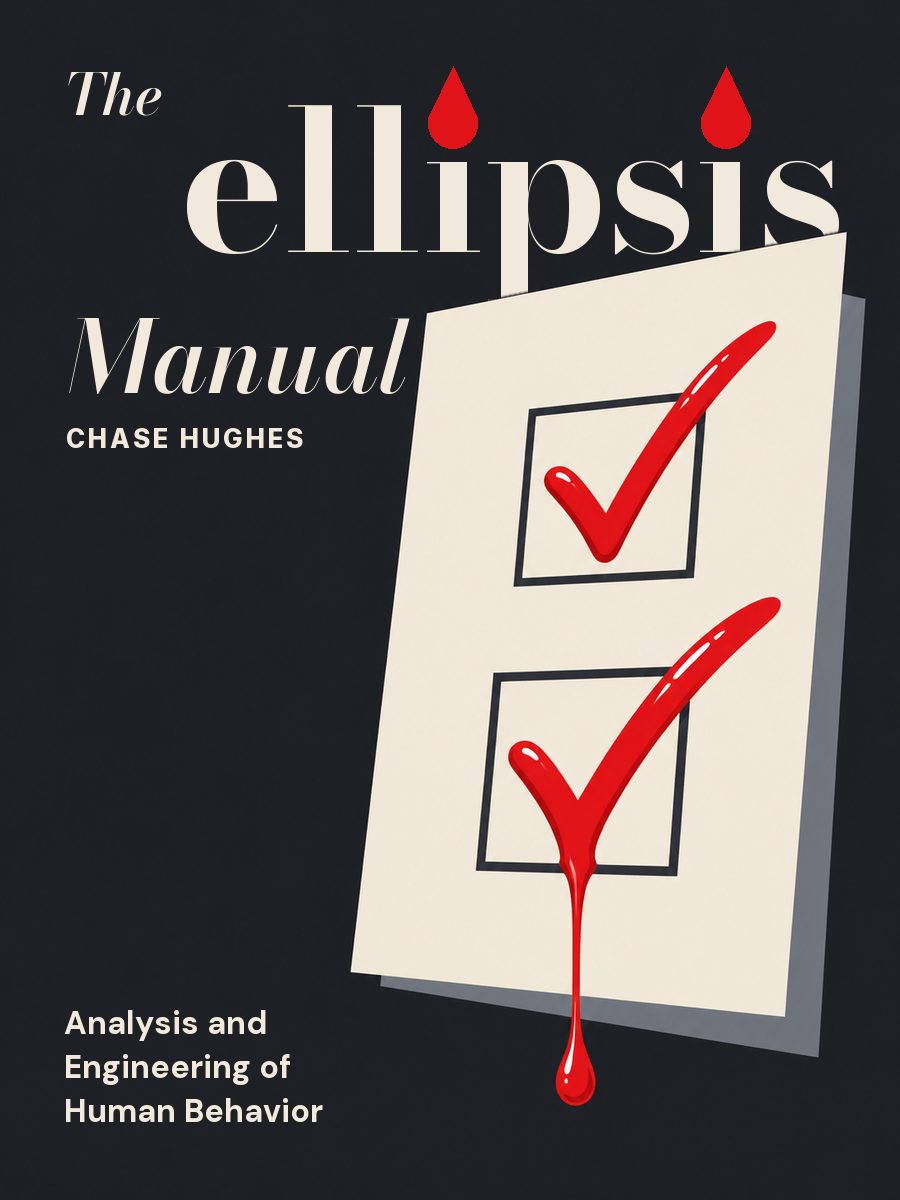
The Ellipsis Manual: Analysis and Engineering of Human Behavior
Why is a decision that feels like yours sometimes made by someone else? An interrogation and profiling specialist gathered everything he knows about reading behavior and hidden influence into one book. Here we take from it what helps you look at people more carefully and notice in time when you're the one being steered.
Who it is for
For anyone learning to read people without jumping to conclusions from a single gesture. And for anyone who suspects their decisions are influenced more often than it seems.
If you're not doing the programming, you are being programmed.
Who's at the wheel
Picture a captain confidently turning the ship's wheel without knowing that someone else is controlling the rudder underwater. This is the image Chase Hughes uses for a person who is being influenced without noticing. The decision feels like their own, but someone else set the course.
Hughes served in the U.S. armed forces and teaches profiling, interrogation methods and psychological operations. He wrote The Ellipsis Manual as a textbook for “operators”: how to read a person's behavior first and then control it. The author himself admits that his techniques cross into a gray area of ethics. Many of them work against the other person's will, and they aren't included here.
Livria takes something else from the book: how the author suggests observing people, and what he knows about the weak spots in our attention. His main idea sounds unsettling: we live by habits, needs and respect for status far more than we think. Whoever understands this is less likely to hand the wheel to someone else.
A table of a hundred gestures and its limits
Hughes put together a behavioral table of elements: more than a hundred gestures, facial expressions and speech habits, each with its own rating for how likely it is to signal deception. In the book he walks through an example interrogation and adds up points for a one-shoulder shrug and for a long story about the suspect's own merits instead of an answer. It looks like an exact science, but it's the author's system, not a proven lie detector.
More important are the places where Hughes qualifies his own claims. Compressed lips, he writes, usually mean that a person is keeping their opinion to themselves, and that isn't necessarily a lie at all. Innocent people under interrogation are also afraid, angry and defensive. And if the questioner pushes and accuses, he himself triggers signs of stress that are easy to mistake for deception later.
That's why the author sticks to two rules. The first rule: you need a baseline, that is, how a person behaves in a calm conversation about simple topics. Only a departure from that person's own norm counts as a signal. The second rule: look at a cluster of movements in response to a single question, not at one gesture in isolation. Hughes honestly adds that some specialists don't trust the baseline either.
Before you decide that someone is lying or nervous, compare them with themselves on a calm day. And ask yourself whether they might be responding to your tone right now.
About the author
Chase Hughes joined the U.S. military in 1998. He teaches behavior profiling, interrogation methods and psychological operations. He runs the company Ellipsis Behavior Laboratories in Virginia Beach.
All books by this author: Chase Hughes
The Ellipsis Manual: Analysis and Engineering of Human Behavior Quiz
Terms from the book
- Autopilot
- Baseline
- Yale
- Milgram
- Cialdini
- Profiling: Building a psychological portrait of a person from their behavior, speech and appearance. The word names both a profession and a set of methods.
- Needs map: Chase Hughes's scheme, not a scientific classification: seventeen needs in the first version and seven in the new one, for example the need for approval, acceptance or admiration, each with its own fear and weakness.
- Double bind: A question with two possible answers, each of which leads to the same outcome the asker wants. A question like this creates the impression of a choice.
- Consistency principle: Described by Robert Cialdini: people try to act in line with what they've already agreed to, so a small “yes” makes the next one easier.
Similar books
- The End of Burnout: Why Work Drains Us and How to Build Better Lives, Jonathan Malesic
- The Fifth Risk, Michael Lewis
- The Gift of Fear, Gavin de Becker
- The Good Enough Job: Reclaiming Life from Work, Simone Stolzoff
- The Hidden Life of Trees: What They Feel, How They Communicate: Discoveries from a Secret World, Peter Wohlleben
- The History of Jazz, Ted Gioia
- The Like Switch, Jack Schafer, Marvin Karlins
- The Person and the Situation: Perspectives of Social Psychology, Lee Ross, Richard E. Nisbett
- The Emperor of All Maladies: A Biography of Cancer, Siddhartha Mukherjee
- The Energy of Money, Maria Nemeth