
The key ideas
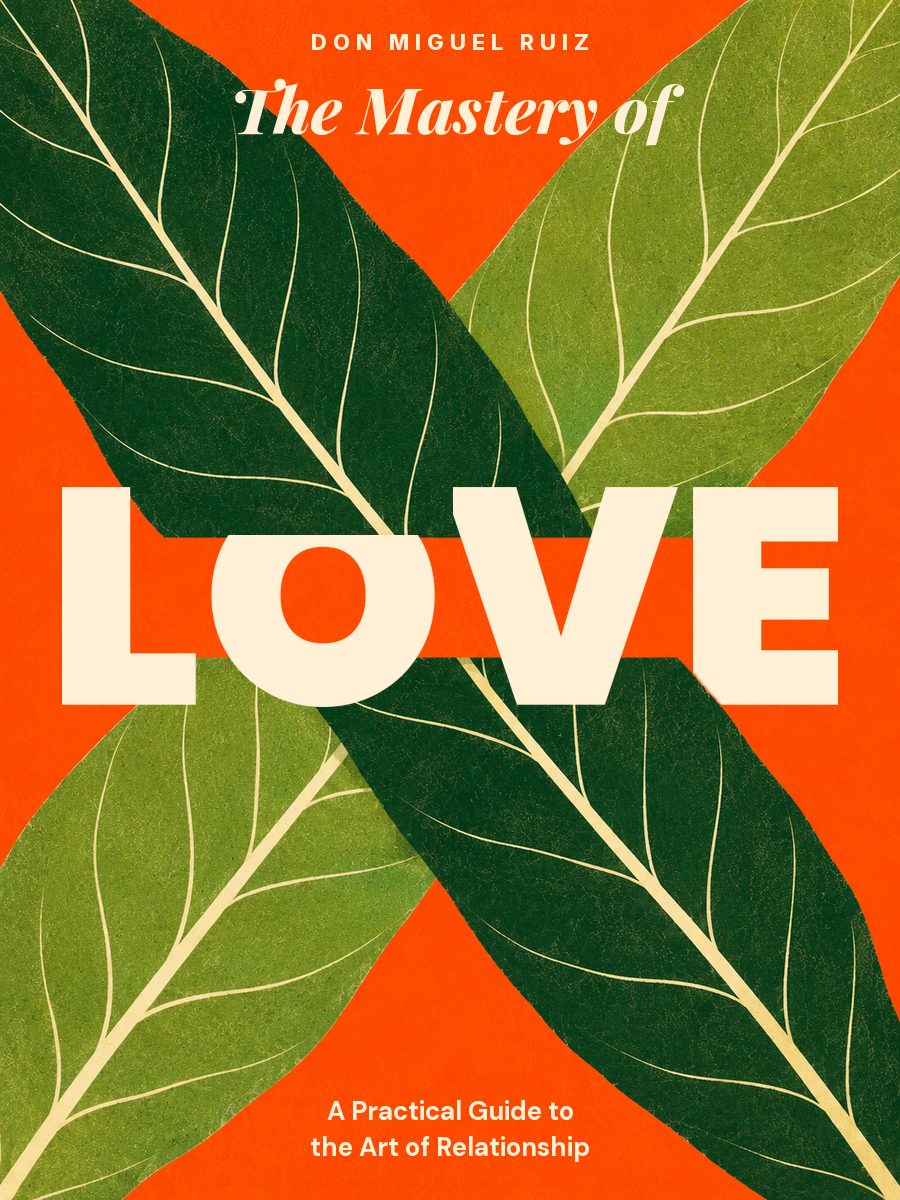
The Mastery of Love: A Practical Guide to the Art of Relationship
Why do two people who love each other end up keeping score, guarding sore spots and fighting for control? Don Miguel Ruiz answers with a planet of wounded skin, a star that falls and breaks, a kitchen that can cook any meal and a dog that will never say “meow”. His claim is that love, like anger or jealousy, is learned by practice, and that the work starts with our own half of the relationship.
Who it is for
For anyone who keeps having the same quarrel with the people they love. For those who wait for a partner to make them happy and feel let down each time. For readers of The Four Agreements who want to see how the same Toltec ideas work in love.
It’s better to be with someone who wants to be with you than to be with someone who has to be with you.
A planet where everyone's skin hurts
Imagine a planet where everyone's skin is covered in infected wounds. Babies are born healthy, the first wounds appear at three or four, and by adolescence wounds cover the whole body. People there barely touch, and when someone brushes a sore, the hurt person gets angry and touches the other’s wound to get even.
Don Miguel Ruiz, a teacher in the Toltec tradition, pictures this planet in the first chapter of The Mastery of Love, then moves the wounds inside. They sit in the emotional body, the part of us that feels, and hold emotional poison: anger, envy, jealousy, sadness. When someone says “you are pushing my buttons”, in his reading you have touched a wound. The Toltecs, he writes, call a world like this the dream of hell.
After The Four Agreements, Ruiz applies the same images to love. They are his metaphors, not science. His starting point is uncomfortable: we are already masters of anger and jealousy, practised since childhood.
A quarrel is ping-pong with poison
How does a wound open? Through injustice, Ruiz answers. A child of two or three plays with Daddy's guitar like a toy. The father, troubled by his business, comes in and spanks the child. What hurts most is not the blow but the sense of injustice: that, Ruiz says, is the knife that opens the wound.
The anger or fear we hold on to can infect the wound. When poison builds up, we release it by hooking someone's attention. Ruiz describes a wife nursing a grievance against her husband while he is out; once he is home, she talks until he flares up. She feels relief; he now holds her poison and his own, and sends both back. They play ping-pong until one of them explodes.
No one is to blame, Ruiz insists, just as nobody on the wounded planet is guilty of being ill. What changes the game is awareness: once you see the ball coming, you can let it pass.
About the author
Don Miguel Ruiz (born 1952) is a teacher in the Toltec mystery-school tradition who, by the book's account, has guided apprentices toward personal freedom for more than two decades. The book's publication details list him as a doctor of medicine; he also wrote The Four Agreements.
All books by this author: don Miguel Ruiz
Terms from the book
- Toltecs
- Jesus
- Buddha
- emotional body: Ruiz's name for the part of us that perceives and feels emotions. An image from the book, not a medical term.
- emotional poison: In the author's image, the anger, envy, jealousy and sadness that infect an emotional wound and get passed from person to person.
- dream of hell: The Toltec name, in Ruiz's book, for a world where people relate through fear, judgment and punishment. A metaphor, not a religious claim about the afterlife.
- magical kitchen: Ruiz's image of a heart that can make any amount of love, so that its owner never has to trade freedom for a little of someone else's.
- track of fear: The author's name for a way of relating built on obligations, expectations, pity and conditions. Its opposite he calls the track of love. A point of reference, not a diagnosis.
- Krishna: A Hindu deity, a central figure of the Bhagavad Gita. Ruiz names him beside Jesus and Buddha as another who taught the same.
- denial system: In the author's model, the lies we tell others and ourselves to protect our emotional wounds; he compares it to a wall of fog in front of the eyes.
Similar books
- The Four Agreements, don Miguel Ruiz
- The Mom Factor: Dealing with the Mother You Had, Didn't Have, or Still Contend With, Henry Cloud, John Townsend
- The Montessori Method, Maria Montessori
- The Power of the Pussy: How to Get What You Want from Men, Kara King
- The Seven Principles for Making Marriage Work, John Gottman, Nan Silver
- Toxic Parents: Overcoming Their Hurtful Legacy and Reclaiming Your Life, Susan Forward, Craig Buck
- The Whole-Brain Child, Daniel J. Siegel, Tina Payne Bryson
- Why Does He Do That? Inside the Minds of Angry and Controlling Men, Lundy Bancroft
- The Millionaire Next Door: The Surprising Secrets of America's Wealthy, Thomas J. Stanley, William D. Danko
- The Miracle Morning: The Not-So-Obvious Secret Guaranteed to Transform Your Life (Before 8AM), Hal Elrod