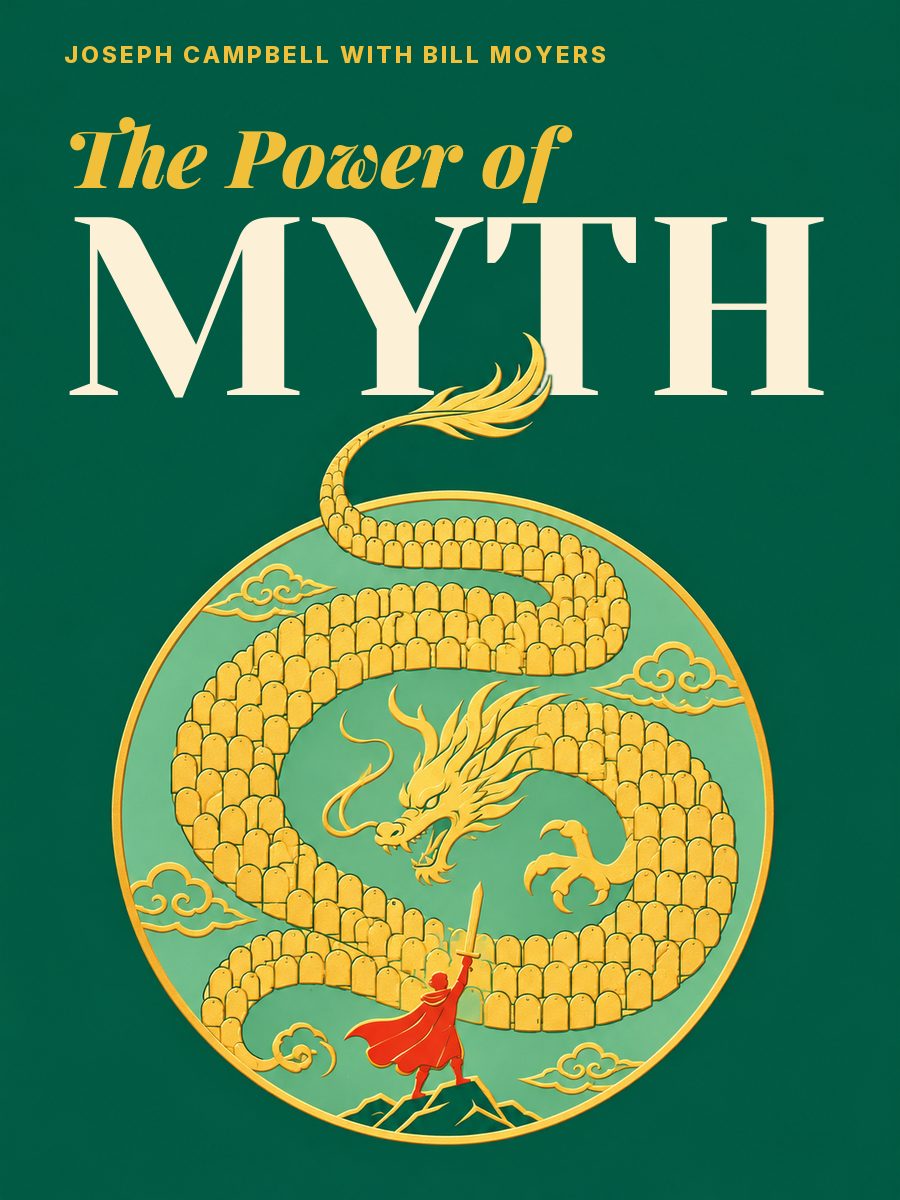

The key ideas
The Power of Myth
What does a twentieth-century person need ancient stories of gods and heroes for? In conversations with the journalist Bill Moyers, the mythologist Joseph Campbell shows that the same plots live on among hunters, in the Bible, in the Grail legends and in Star Wars. Myth, as he sees it, is neither a lie nor naive science but a metaphor that helps us grow up, love and find our bliss.
Who it is for
For anyone who feels they are living by someone else’s rules, and for anyone surprised that the myths of different peoples are so alike.
People say that what we’re all seeking is a meaning for life. I don’t think that’s what we’re really seeking. I think that what we’re seeking is an experience of being alive.
“We don’t have theology. We dance”
At an international conference on religion in Japan, an American philosopher from New York complained to a priest of Shinto, Japan’s traditional religion. He had been to many ceremonies but still didn’t get their ideology or their theology. The priest thought for a while and shook his head: “I think we don’t have ideology. We don’t have theology. We dance.” Joseph Campbell loved this story more than many others.
Campbell taught mythology for almost forty years and compared the tales of the whole world. In 1985 and 1986 the journalist Bill Moyers recorded long conversations with him for television, and this book grew out of them. Moyers asks a simple question: why do we need ancient stories of gods and heroes today?
Campbell’s answer is unexpected. People say they are seeking the meaning of life, but he believes we are seeking something else: the experience of being alive. Myths, as he sees it, are clues to that experience. They don’t so much explain how the world works as help us get through life: growing up, loving, losing and growing old.
Don’t eat the menu
Campbell explains what a metaphor is with the example of a restaurant. You take the menu, see the word “beefsteak” and start chewing the paper. That, he says, is what a person does who takes a religious image for a statement of fact.
His example is the ascension of Christ. Read literally, it means a body rose into the sky, but there is no physical heaven in the universe to rise to, he points out. If the image is understood as a metaphor, though, the ascension is a journey inward, to the source of life within the person. Every religion, in Campbell’s view, is true when it is understood metaphorically.
Hence his advice, which comes as a surprise: read the myths of other traditions, not your own. We are used to interpreting our own as a set of facts, while in someone else’s we hear the meaning at once. Campbell admits he was afraid of destroying his students’ faith, but the opposite happened: Christians, Jews and Buddhists saw their own tradition afresh.
The trouble begins where a metaphor is turned into a fence. Campbell finds the most terrible example in Beirut: the three great religions of the West call the same biblical God by different names and can’t get along, because each is stuck on its own image.
About the author
Joseph Campbell (1904–1987) was an American scholar of myth who taught at Sarah Lawrence College for almost forty years and wrote The Hero with a Thousand Faces. This book was put together from his television conversations with the journalist Bill Moyers.
All books by this author: Joseph Campbell
Terms from the book
- Buddha
- Lewis
- metaphor
- Moses
- Nietzsche
- Woodstock
- Schopenhauer
- Shinto: The traditional religion of Japan, the worship of kami, spirits of nature and of ancestors.
- Moyers: Bill Moyers (1934–2025), an American journalist. In 1985 and 1986 he recorded the television conversations The Power of Myth with Campbell for PBS.
- Beirut: The capital of Lebanon. At the time of the conversations a civil war was going on there in which Christians and Muslims clashed.
- Confirmation: A Christian rite in which a teenager confirms the faith received at baptism. Among Catholics it is performed by a bishop.
- The Hero with a Thousand Faces: Campbell’s first book, published in 1949. In it he described the hero’s journey common to the world’s myths: departure, trials, return.
- Babbitt: The hero of Sinclair Lewis’s 1922 novel of the same name, a prosperous businessman who admits at the end that he has never once done what he wanted.
- Ananda: A Sanskrit word meaning “bliss.” Together with Sat, being, and Chit, consciousness, it describes the highest reality in Indian thought.
- Daedalus: A master craftsman from Greek myth. He made wings for himself and his son Icarus to escape from Crete; Icarus flew too high and fell into the sea.
- Grail: A cup from medieval legends, in one version the cup of the Last Supper. In the romances of chivalry the quest for it stands for the path to the highest spiritual goal.
- Perceval: A knight of the Round Table and hero of the Grail legends, who grew up in the forest far from the court.
- Wasteland: An image from the Grail legends, the dead land around the castle of the wounded king. Campbell, following the poet T. S. Eliot, sees in it the world of people who are not living their own lives.
Similar books
- The Psychology of Interpersonal Behaviour, Michael Argyle
- The Revolution of Hope: Toward a Humanized Technology, Erich Fromm
- The Righteous Mind: Why Good People Are Divided by Politics and Religion, Jonathan Haidt
- The Sixth Extinction: An Unnatural History, Elizabeth Kolbert
- The Social Climber's Bible: A Book of Manners, Practical Tips, and Spiritual Advice for the Upwardly Mobile, Dirk Wittenborn, Jazz Johnson
- The Uninhabitable Earth: Life After Warming, David Wallace-Wells
- Third Culture Kids: Growing Up Among Worlds, David C. Pollock, Ruth E. Van Reken
- The Tipping Point, Malcolm Gladwell
- The Power of the Pussy: How to Get What You Want from Men, Kara King
- The Power of When, Michael Breus