The key ideas
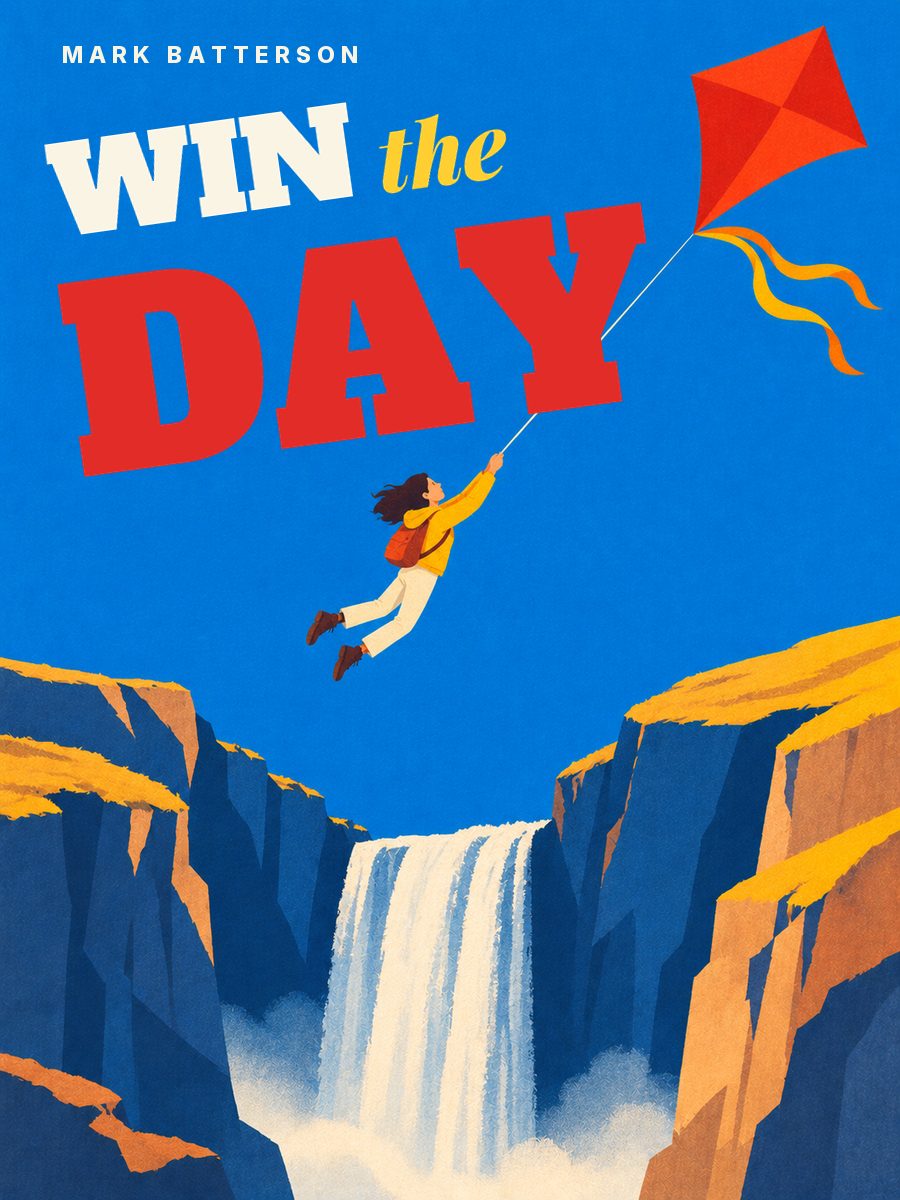
Win the Day: 7 Daily Habits to Help You Stress Less & Accomplish More
Most of us carry yesterday's regrets and tomorrow's fears into every day, and then wonder why we feel overloaded. Mark Batterson, a Washington pastor, suggests shrinking life down to one day and offers seven habits for it: two to make peace with the past, two to win the day itself and three to move toward the future.
Who it is for
For people who are worn out by yesterday's mistakes and tomorrow's worries and want to know where to begin today.
Almost anybody can accomplish almost anything if they work at it long enough, hard enough, and smart enough.
A question you can say yes to
On a rafting trip through the Grand Canyon, Mark Batterson heard a question from his friend Matthew Barnett. Barnett asks it of people at the Los Angeles Dream Center who are trying to rebuild their lives: "Can you do it for a day?" A year seems too much. A day seems doable.
That question carries the whole book. Batterson borrows an image from the physician William Osler, who in 1913 urged Yale students to live in day-tight compartments: shut out the past you cannot change and the future you cannot control. In Batterson's view, it is this double load that wears us down, not the day itself.
Batterson is a pastor, and the book is openly Christian: prayer stands right next to habits. If you want God to do the super, he writes, you have to do the natural. His seven habits help you bury dead yesterdays, win the day and imagine unborn tomorrows.
The story you tell about yesterday
Bo Eason came to his first high school practice five feet tall and a hundred pounds, too small for football in the coach's eyes. His father told him why ranchers keep the runt of a litter of herding dogs: the smallest puppy has to work hardest, and it grows up the most determined. Bo made that his story. He vowed to be the first on the practice field and the last to leave. In 1984 he was the first safety chosen in the NFL draft.
This is the first habit, flip the script. In Batterson's view, our explanations matter more than our experiences, because the stories we tell ourselves tend to come true.
The second habit, kiss the wave, is about pain that cannot be rewritten. You may not be responsible for what happened, Batterson says, but you are response-able: the choice of response stays with you. When his wife Lora was diagnosed with breast cancer, she held on to a question from a poem: "What have you come to teach me?" We try so hard to get out of hard seasons, he notes, that we get nothing out of them.
About the author
Mark Batterson is the lead pastor of National Community Church in Washington, DC, and the author of about twenty books, including The Circle Maker. He writes as a Christian, and prayer sits next to habits in his books.
All books by this author: Mark Batterson
Win the Day: 7 Daily Habits to Help You Stress Less & Accomplish More Quiz
Terms from the book
- UCLA
- Grand Canyon
- Tharp
- Wooden
- Peterson
- Elijah
- Barnett: Matthew Barnett, an American pastor and cofounder of the Los Angeles Dream Center, which helps people trying to rebuild their lives, including people with addictions.
- Osler: Sir William Osler (1849-1919), a Canadian physician, one of the founders of Johns Hopkins School of Medicine. In 1913 he spoke to Yale students about living in day-tight compartments.
- day-tight compartments: Osler's image: like a ship that seals off its compartments, a person shuts out yesterday and tomorrow and lives only the current day.
- Eason: Bo Eason, a former American football player in the NFL. He later turned his life story into the stage play Runt of the Litter.
- NFL: The National Football League, the main professional American football league in the United States.
- draft: The yearly selection in which professional teams take turns choosing young players from college teams.
- response-able: Batterson's play on the word responsible: you may not be to blame for what happened, but you are able to choose your response.
- Lora: Lora Batterson, the author's wife. The book tells how she faced a breast cancer diagnosis.
- predecision: Batterson's word for a decision made in advance, so that in the moment there is nothing left to decide.
- habit stacking: Attaching a harder habit to one that already comes easily, so that the first one pulls the second one along.
- Walsh: Homan Walsh, an American teenager who in 1848, at fifteen, flew a kite across the Niagara Gorge, and the first line of a future bridge was pulled across behind it.
- Niagara Gorge: The deep river canyon below Niagara Falls on the border between the United States and Canada.
- Gaines: Rowdy Gaines, an American swimmer who won three gold medals at the 1984 Olympics.
- Otis: Elisha Otis (1811-1861), an American inventor of the safety brake for elevators, which made tall buildings practical.
- kingfisher: A small bright bird that catches fish by diving into the water from a perch.
- Stanley: Andy Stanley, an American pastor and author. Batterson quotes his remark that you are probably never going to be more than about 80 percent certain.
Similar books
- Working Identity: Unconventional Strategies for Reinventing Your Career, Herminia Ibarra
- Year of Yes: How to Dance It Out, Stand in the Sun and Be Your Own Person, Shonda Rhimes
- You Are a Badass: How to Stop Doubting Your Greatness and Start Living an Awesome Life, Jen Sincero
- Your Erroneous Zones, Wayne Dyer
- 13 Things Mentally Strong People Don't Do, Amy Morin
- The 7 Habits of Highly Effective People, Stephen Covey
- A Mind for Numbers: How to Excel at Math and Science, Barbara Oakley
- Atomic Habits, James Clear
- Winning, Jack Welch, Suzy Welch
- Wintering: The Power of Rest and Retreat in Difficult Times, Katherine May