
Book quiz
Blue Ocean Strategy: How to Create Uncontested Market Space and Make the Competition Irrelevant Quiz
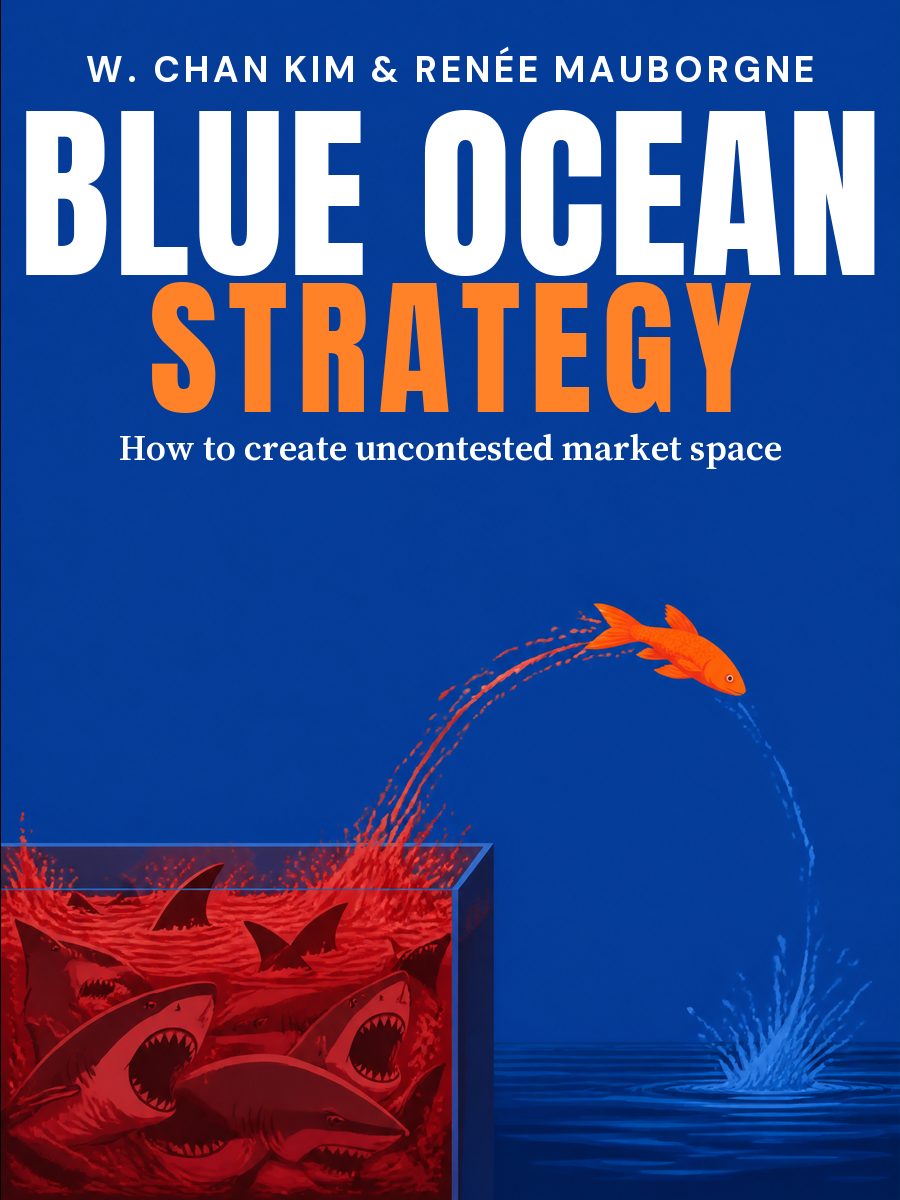 Blue Ocean Strategy: How to Create Uncontested Market Space and Make the Competition IrrelevantW. Chan Kim, Renée Mauborgne
Why do some companies spend years fighting over the same customers, while others create a market where there are simply no rivals? W. Chan Kim and Renée Mauborgne studied 150 strategic moves across more than a hundred years and found a common logic in them. You'll learn how to cut what isn't needed, find buyers among…
Question 1 of 5
There are five similar coffee shops on one street, and they're all cutting prices and giving away cookies. What happens, according to the book?
Show the answer
Right answer: Customers drift from door to door, and everyone's profit melts away
This is a red ocean: there are no more customers, they're just pulled back and forth, and one shop's gain is paid for by another's loss.
Question 2 of 5
You want to make a product both cheaper and more valuable at once. How is that possible, in the authors' view?
Show the answer
Right answer: Remove what the industry takes for granted and create what didn't exist
Value innovation breaks the choice between expensive and cheap: what you remove lowers costs, what you create raises value. Cirque du Soleil didn't invent anything new.
Question 3 of 5
You're looking for new demand for your business. Who do Kim and Mauborgne advise looking at?
Show the answer
Right answer: The people who don't buy from you, and what they have in common
Noncustomers know things about the market that regular buyers won't tell you. Look for what they share, instead of slicing the market into ever narrower pieces.
Question 4 of 5
In what order do the authors advise testing a new idea?
Show the answer
Right answer: Usefulness, price, costs, and adoption only at the end
First usefulness to the buyer, then a price for the mass of people, then costs. The price is set before costs are counted, and the Philips CD-i shows what the reverse order can lead to.
Question 5 of 5
You're bringing unwelcome changes to your team. According to the book, what will help people accept them?
Show the answer
Right answer: Ask their opinion, explain the reason and spell out expectations
This is fair process. At the Elco plant where the changes were simply announced, the workers were outraged, while where everything was explained in advance, the changes went well.
Want all of the book's key ideas? Read or listen to its retelling in Livria.