
Book quiz
Cosmos Quiz
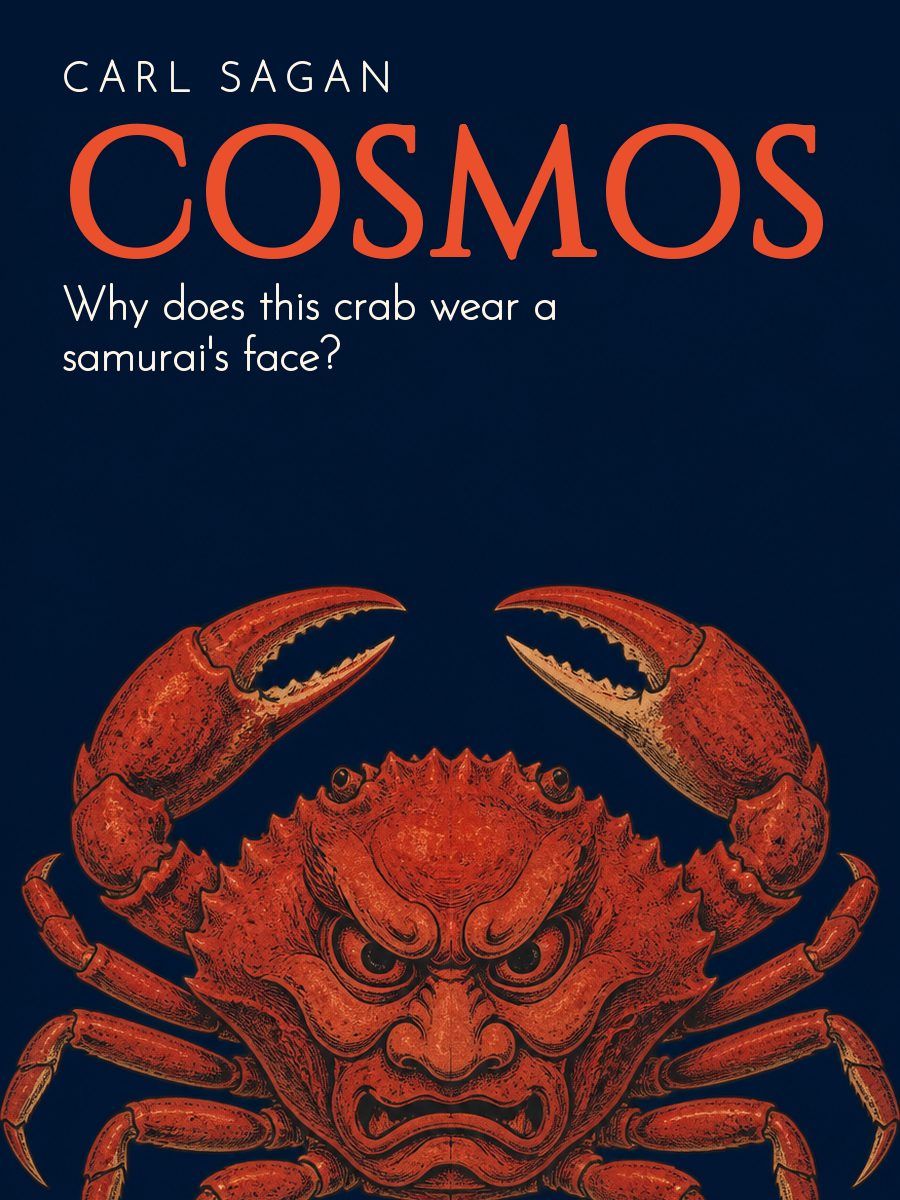 CosmosCarl Sagan
More than two thousand years ago, a man measured the Earth with a stick and a shadow. Carl Sagan tells the history of science as a drama, where curiosity argues with superstition and testing argues with the wish to believe. From Kepler and the canals of Mars to the stars where the atoms of our bodies were born, this…
Question 1 of 5
How did Eratosthenes realize that the Earth's surface is curved?
Show the answer
Right answer: He noticed that at the same hour, sticks in two cities cast different shadows
In Syene a stick cast no shadow at noon, but in Alexandria it did. On a flat Earth the shadows would be the same, so the surface must be curved.
Question 2 of 5
What made Kepler give up a circular orbit for Mars?
Show the answer
Right answer: A gap of eight minutes of arc with Tycho Brahe's data
The best circle differed from Tycho's observations by eight minutes of arc. Kepler knew Tycho didn't make errors that large, and he let go of a beautiful idea.
Question 3 of 5
In every short message from someone important to you, you see a hidden meaning. Which story from the book is this like?
Show the answer
Right answer: Lowell, who saw canals on Mars that weren't there
Sagan explains Lowell's canals this way: the eye joined spots into lines, and a strong desire to see life completed the picture.
Question 4 of 5
Why does Sagan say we are made of star-stuff?
Show the answer
Right answer: The heavy elements in our bodies were born inside stars
Carbon, oxygen and iron were born in stars and scattered when the stars died. The iron in your blood and the calcium in your teeth passed through stars.
Question 5 of 5
Which factor in the Drake equation worries Sagan most?
Show the answer
Right answer: How long a technical civilization lives without destroying itself
Sagan fears that many civilizations destroy themselves soon after they master destructive technology.
Want all of the book's key ideas? Read or listen to its retelling in Livria.