
Book quiz
Crucial Conversations: Tools for Talking When Stakes Are High Quiz
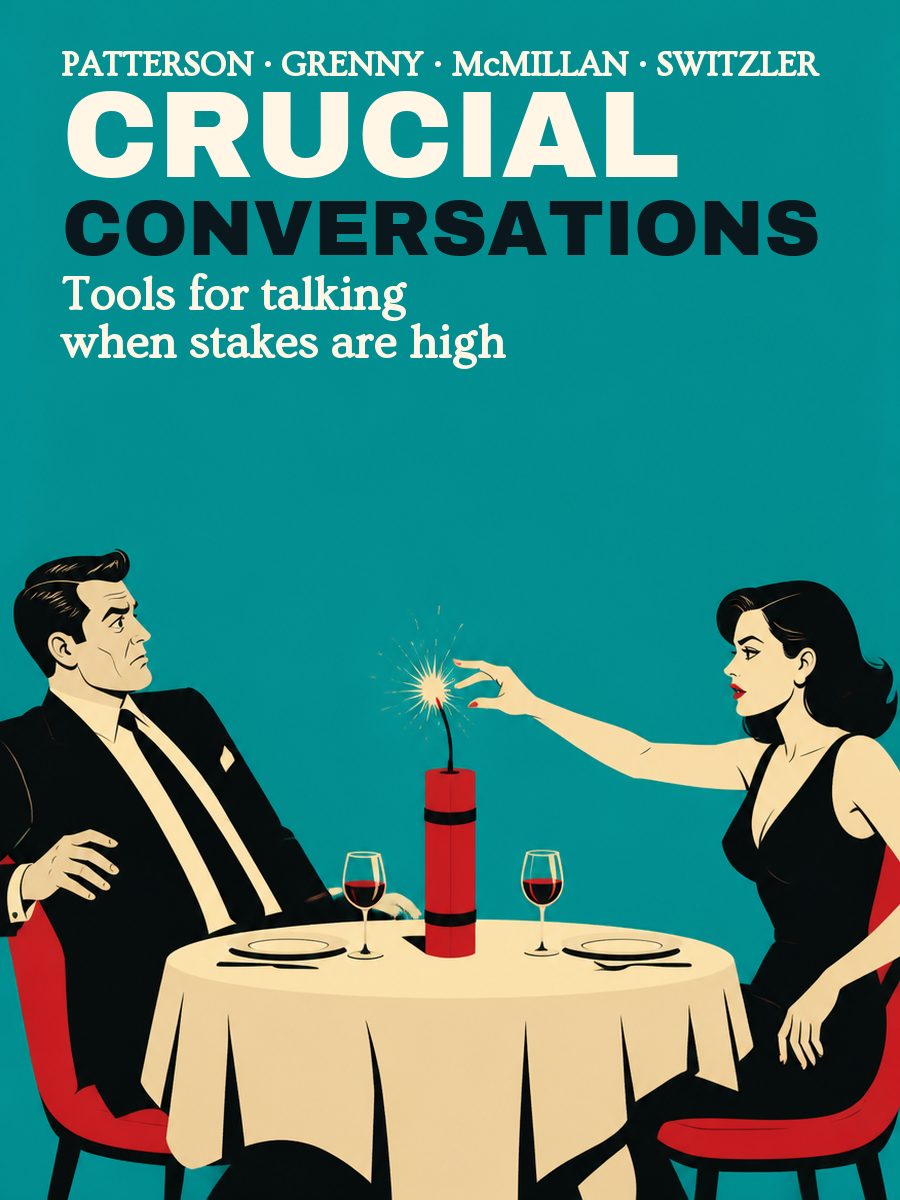 Crucial Conversations: Tools for Talking When Stakes Are HighKerry Patterson, Joseph Grenny, Ron McMillan, Al Switzler
A woman finds a payment to a motel near home on a statement and decides within a minute that her husband is having an affair. What she says next could change everything. A book about conversations where opinions differ, stakes are high, and emotions run strong, and how to avoid choosing between silence and attack.
Question 1 of 5
The boss asks "Any objections?" in a way that makes everyone go quiet, and a month later the decision is quietly sabotaged. Why?
Show the answer
Right answer: People didn't feel safe and retreated into silence
In the authors' model, without safety people retreat into silence or violence. The pool of shared meaning doesn't fill up, and no one considers the shared decision their own.
Question 2 of 5
A friend asks about her business plan, and you have doubts. What do the authors call the Fool's Choice?
Show the answer
Right answer: A false dilemma: either the truth or the relationship
The Fool's Choice: either I tell the truth and damage the relationship, or I keep quiet. The third way, like Kevin's, is to be both honest and respectful.
Question 3 of 5
A teenager is rude at dinner, and you want to win the argument. What does "start with heart" mean?
Show the answer
Right answer: Ask yourself what you really want
Under threat, the goal quietly shifts to winning or saving face. Asking what you want for yourself, for the other person and for the relationship brings back the real goal.
Question 4 of 5
Your sister took a request to repay a loan as an accusation. What technique do the authors suggest?
Show the answer
Right answer: Contrasting: say what you don't mean, and then what you do
Contrasting restores respect and safety without canceling your position: "I don't think you're dragging it out on purpose, I just need to understand the timing."
Question 5 of 5
A friend hasn't answered for two days, and you think: "He's offended." What is this, according to the book's model?
Show the answer
Right answer: A story you're telling yourself about a fact
There's only one fact here: no answer. Between the fact and the feeling stands our interpretation, and other versions are possible too: he's busy, he didn't see it, he doesn't know what to say.
Want all of the book's key ideas? Read or listen to its retelling in Livria.