
Book quiz
Homo Deus: A Brief History of Tomorrow Quiz
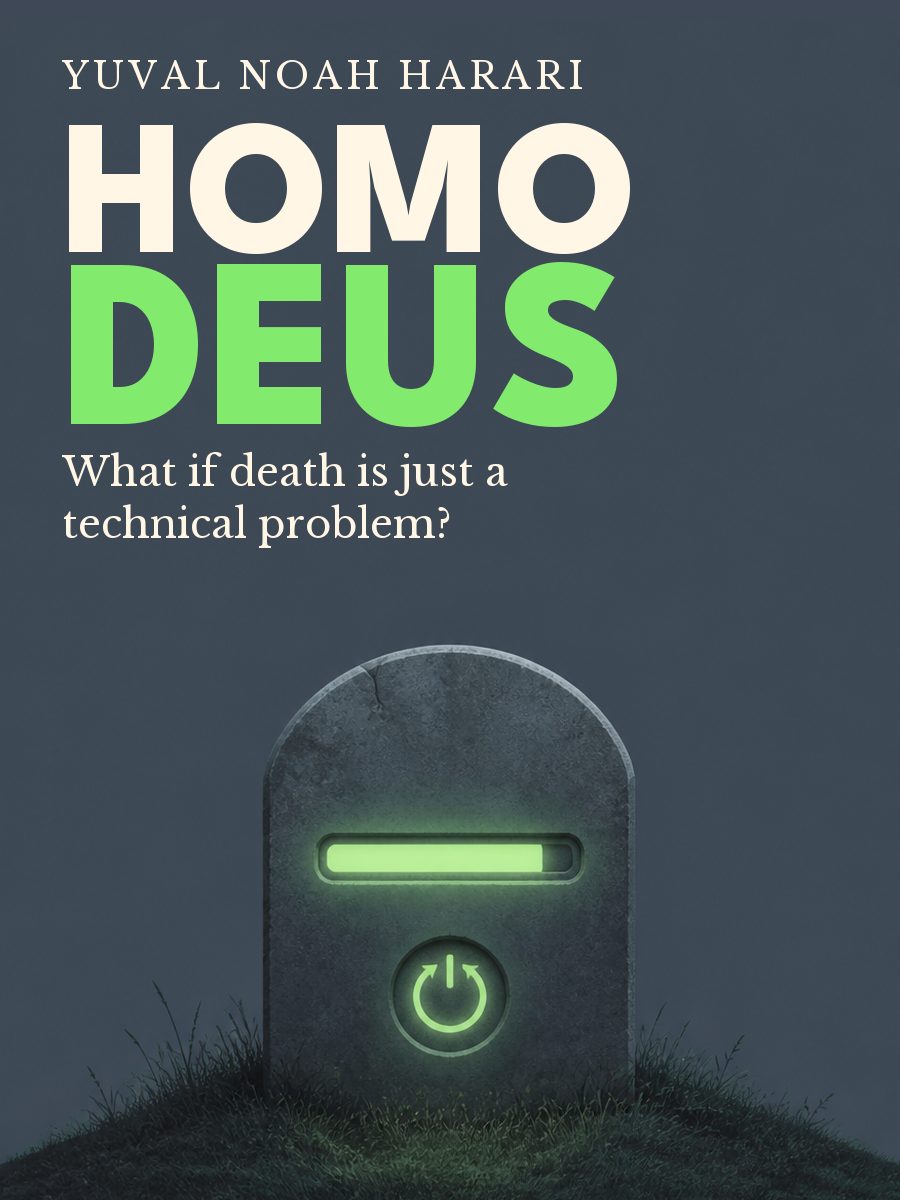 Homo Deus: A Brief History of TomorrowYuval Noah Harari
Today food kills more people than war. For the first time in history, famine, plague and war have retreated, and Harari asks an awkward question: what do people start to want once the old disasters are over? A book about humanity's three new dreams, and about what happens to us when machines begin to understand us…
Question 1 of 5
Average life expectancy has risen from thirty to eighty. According to Harari, what's behind this?
Show the answer
Right answer: Children stopped dying in large numbers
The ceiling of life has barely moved: people lived to eighty in ancient times too. Medicine learned to save people from early death, not to push the limit back.
Question 2 of 5
You bought a new phone, and two weeks later you want the next one. How does Harari explain this?
Show the answer
Right answer: It's by design: evolution gains nothing from contentment
Our genes come from those who, once fed, started worrying and searching again. A good feeling is short by nature: what's pleasant quickly becomes the norm.
Question 3 of 5
According to Harari, why should you know stories like the history of the lawn in front of your house?
Show the answer
Right answer: To free yourself from the past and choose your own desires
As long as you can't see a dream's family tree, it seems to be yours. The lawn was inherited from the aristocracy, and once you know that, you can keep it or let it go.
Question 4 of 5
In the ice-water experiment, why did many people choose to repeat the longer version?
Show the answer
Right answer: The narrating self decides, and it judges by the peak and the end
The narrating self builds its story not from the sum of pain but from the sharpest moment and the ending. The warmer water at the end made the long version better in memory.
Question 5 of 5
According to Harari, how does Dataism determine the value of a thing, a person or an event?
Show the answer
Right answer: By how much data they add to the flow
The new faith puts the flow of data at the center. Its commandments sound familiar: if you experience something, record it, upload it, share it.
Want all of the book's key ideas? Read or listen to its retelling in Livria.