
Book quiz
The Delusions of Crowds: Why People Go Mad in Groups Quiz
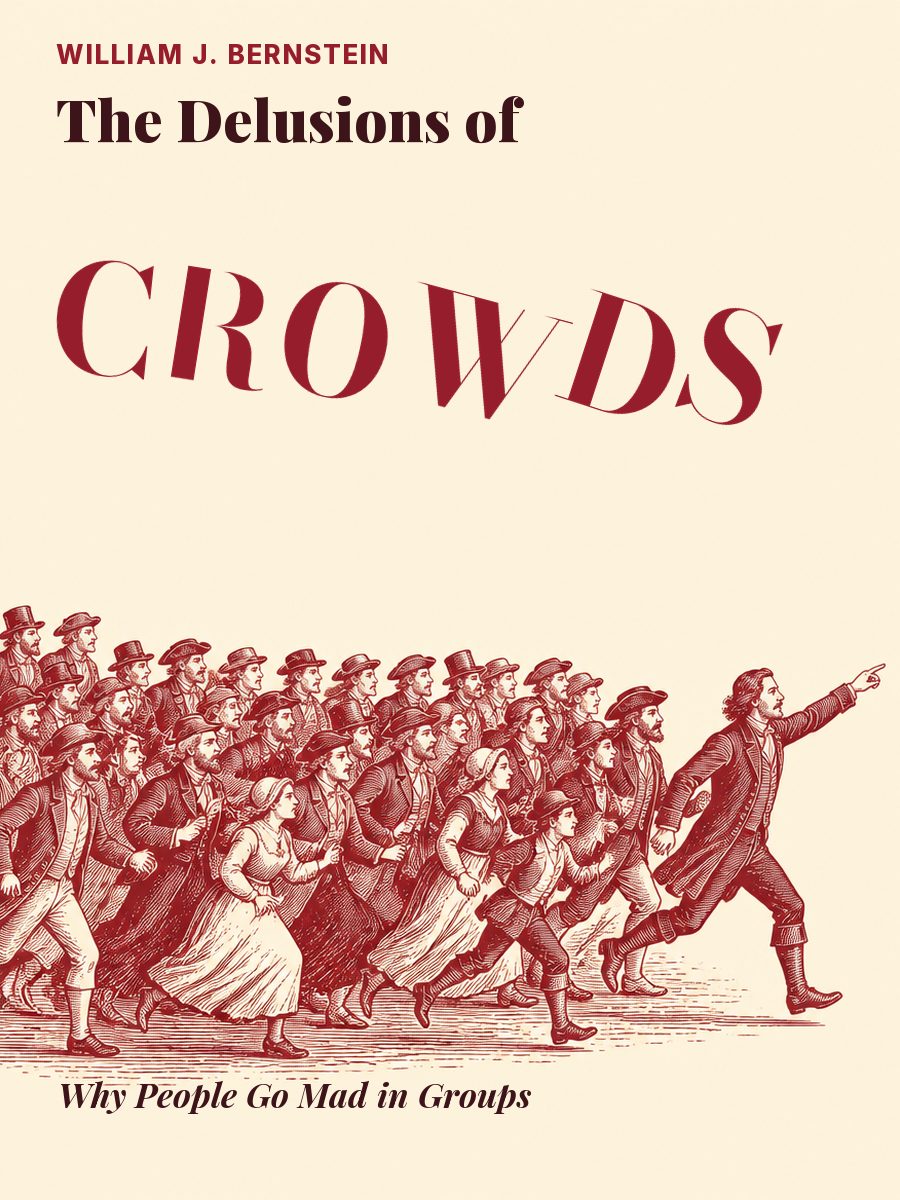 The Delusions of Crowds: Why People Go Mad in GroupsWilliam J. Bernstein
Why does a crowd guess the weight of an ox to within one percent, and then snap up shares that are worth nothing? William Bernstein traces five centuries of mass madness, from besieged Münster to the stock market crash of 1929 and the Islamic State. He shows that money bubbles and the expectation of the end of the…
Question 1 of 4
You need to estimate an apartment's price, and the group chat already has dozens of opinions. According to the book, what should you do?
Show the answer
Right answer: Write down your own estimate first, then read
Greenblatt's students guessed 1,771 jelly beans out of 1,776 while writing their answers silently. When each said a number out loud, the average dropped to 850.
Question 2 of 4
A friend got rich on a trendy purchase, and you want to buy too. According to the book, what should you do?
Show the answer
Right answer: Wait a week before buying
Kindleberger noted that nothing clouds judgment like watching a friend get rich. The flutter in your chest is anticipation, not calculation.
Question 3 of 4
You're almost certain one company's stock will go up. According to the book, how do you test yourself?
Show the answer
Right answer: Look for an example that would prove you wrong
In Wason's experiment with the numbers 2, 4, 6, people tested only examples that fit, and almost nobody tried to prove themselves wrong.
Question 4 of 4
You're promised that an investment will return 25% a year for twenty years in a row. According to the book, what should you think?
Show the answer
Right answer: It's a story, not a sober calculation
In 1929 Raskob promised that 15 dollars a month would become 80,000 in 20 years, which needed about 25% a year. The crash began soon after.
Want all of the book's key ideas? Read or listen to its retelling in Livria.