
Book quiz
The Selfish Gene Quiz
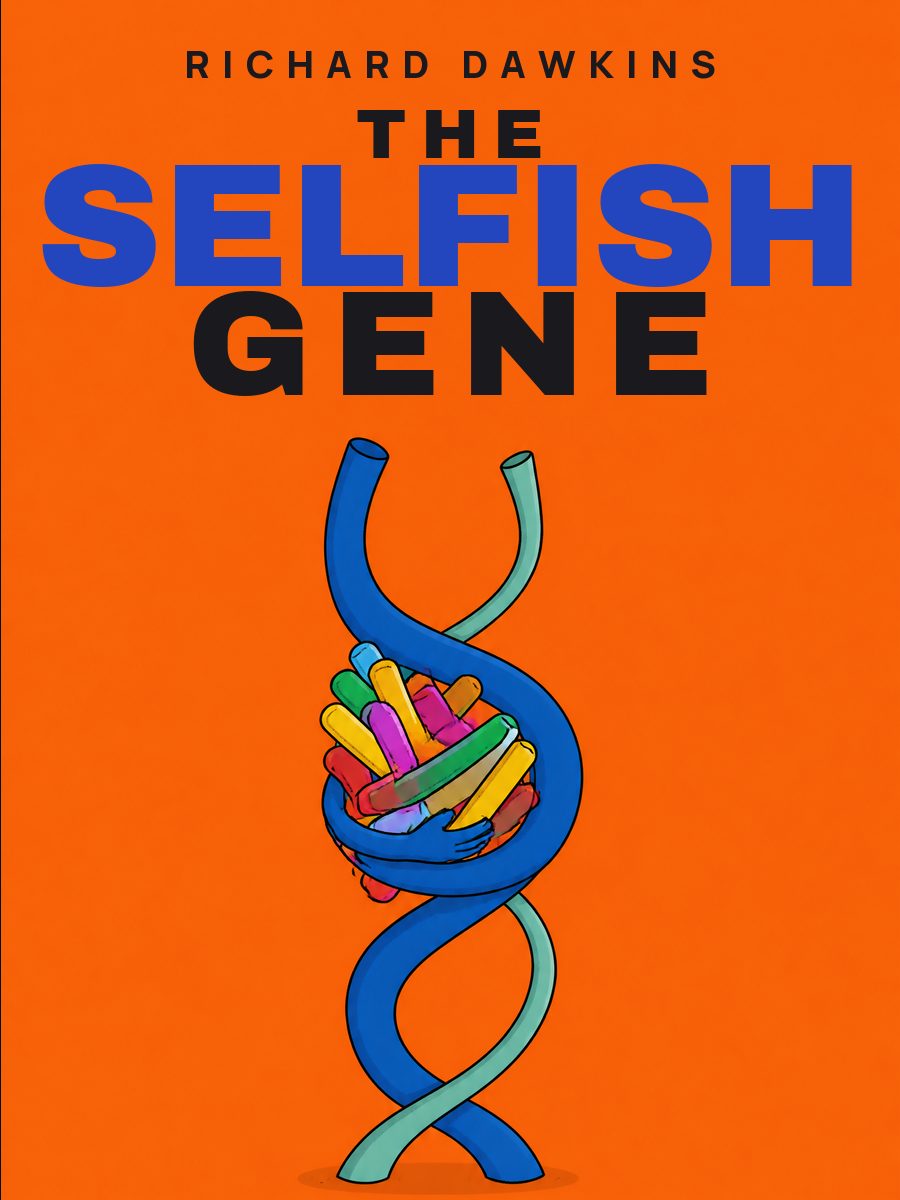 The Selfish GeneRichard Dawkins
Why does a mother risk her life for her young, and why do unrelated birds groom each other's feathers? Richard Dawkins invites you to look at life through the eyes of a gene, and much of what seemed a mystery falls into place. You'll understand how a "selfish" gene builds a generous body, how cooperation arises…
Question 1 of 5
Why does Dawkins see the gene, not the individual animal, as the unit of selection?
Show the answer
Right answer: An individual is never repeated, while a gene survives the shuffle
In sexual reproduction, sets of genes get shuffled. Only what repeats can be selected, and what repeats is a short stretch: the gene.
Question 2 of 5
What does Dawkins mean by calling a gene "selfish"?
Show the answer
Right answer: A gene that copies itself better simply becomes more common
A gene has no wishes and no character. "Selfish" here is a handy shorthand, "as if" language, not a story about intentions.
Question 3 of 5
Someone says birds lay few eggs for the good of the species. What question does Dawkins advise asking?
Show the answer
Right answer: What happens to the first one who doesn't do this?
An individual with a gene that says to lay more will leave more offspring, and the very first rule-breaker will wreck a self-sacrificing group.
Question 4 of 5
Why might a gene for sacrificing yourself for five brothers win out, but lose for five cousins?
Show the answer
Right answer: A brother carries a shared gene with probability 1/2, a cousin 1/8
Kin selection: by saving relatives, a gene saves copies of itself. Five brothers carry more of them in total than die with the body.
Question 5 of 5
Why can an idea keep spreading for a long time even if it's wrong?
Show the answer
Right answer: A meme survives because it's good at being copied
Memes, like genes, compete for attention and memory. What survives is what copies well, not what's true.
Want all of the book's key ideas? Read or listen to its retelling in Livria.