
Book quiz
The Signal and the Noise: Why So Many Predictions Fail, but Some Don't Quiz
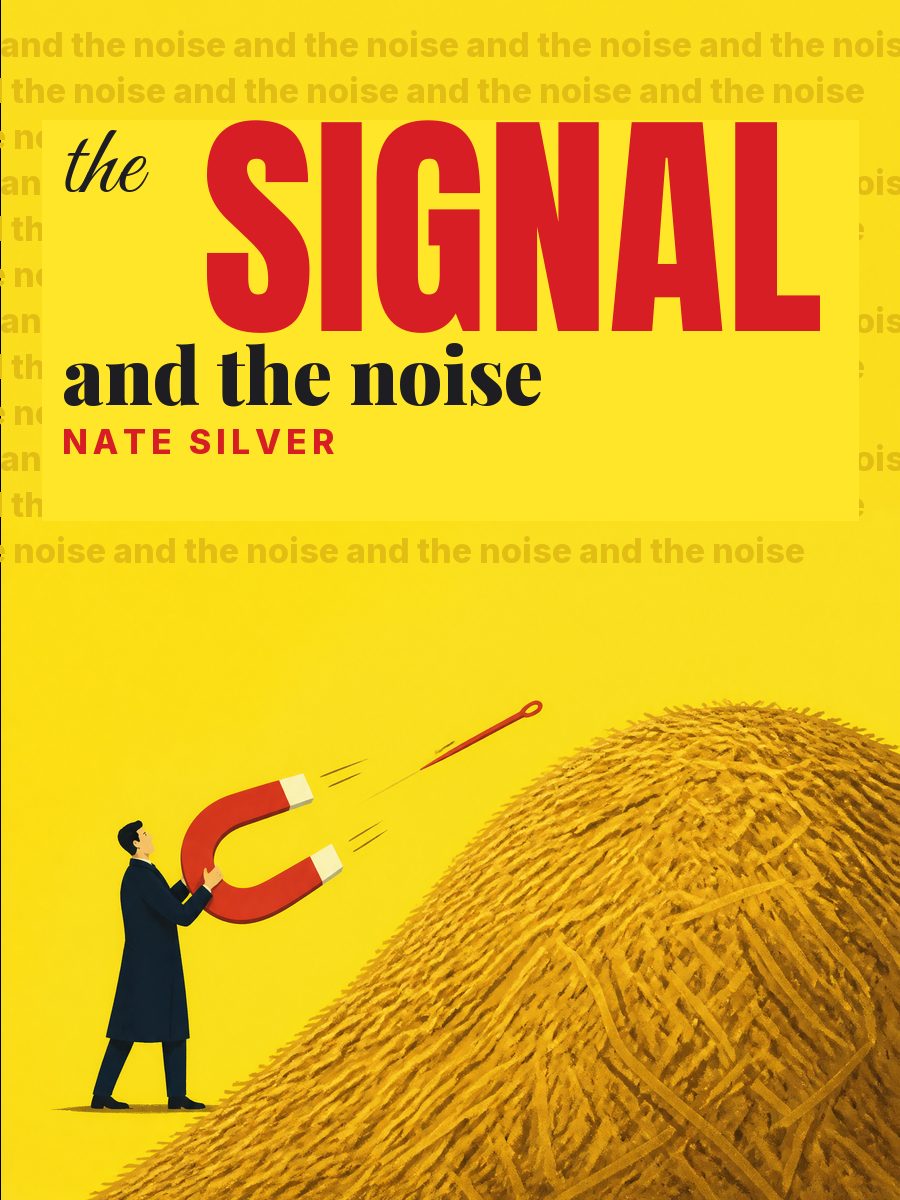 The Signal and the Noise: Why So Many Predictions Fail, but Some Don'tNate Silver
Why were the rating agencies off by a factor of two hundred in 2008, while weather forecasters get more accurate every year? Nate Silver looks at finance, weather, earthquakes, baseball, poker, climate and terrorism. And everywhere he shows the same thing: a forecast fails when noise is mistaken for signal, and it…
Question 1 of 5
You've found a worrying piece of evidence that looks like proof. According to Silver, how do you reason in a Bayesian way?
Show the answer
Right answer: Shift your starting estimate, but not to an extreme
In the example of the underwear in the dresser drawer, the evidence raised the estimate from 4 to about 29 percent. What matters is the estimate you started from, and updating it gradually.
Question 2 of 5
A model explains past data perfectly, every bend included. What does Silver think of this?
Show the answer
Right answer: It may have learned the noise, not the pattern
This is overfitting. At Fukushima, a model fitted to a bend in the data gave "once in thirteen thousand years," while a simple straight line was closer to the truth.
Question 3 of 5
A TV pundit confidently predicts the outcome of an election. According to the book, what question should you ask?
Show the answer
Right answer: How often has he been right before?
Silver checked TV pundits' predictions: about 46 percent were right, almost like a coin. Confidence gets rewarded there, and nobody checks accuracy.
Question 4 of 5
According to Silver, why have weather forecasters become the quiet champions of prediction?
Show the answer
Right answer: They check their forecasts against reality every day
Weather is chaotic and hard. Forecasters win through a combination: they understand the physics, see their mistakes every day and improve the computer forecast by hand.
Question 5 of 5
A commercial channel forecasts a 20% chance of rain, but it rains far less often. According to Silver, why?
Show the answer
Right answer: A slightly "wetter" forecast than the truth pays off for the channel
If sun was promised and it rains, viewers get angry. So the forecast is skewed on purpose: it's always worth asking who benefits from a prediction.
Want all of the book's key ideas? Read or listen to its retelling in Livria.