
Book quiz
Why Nations Fail Quiz
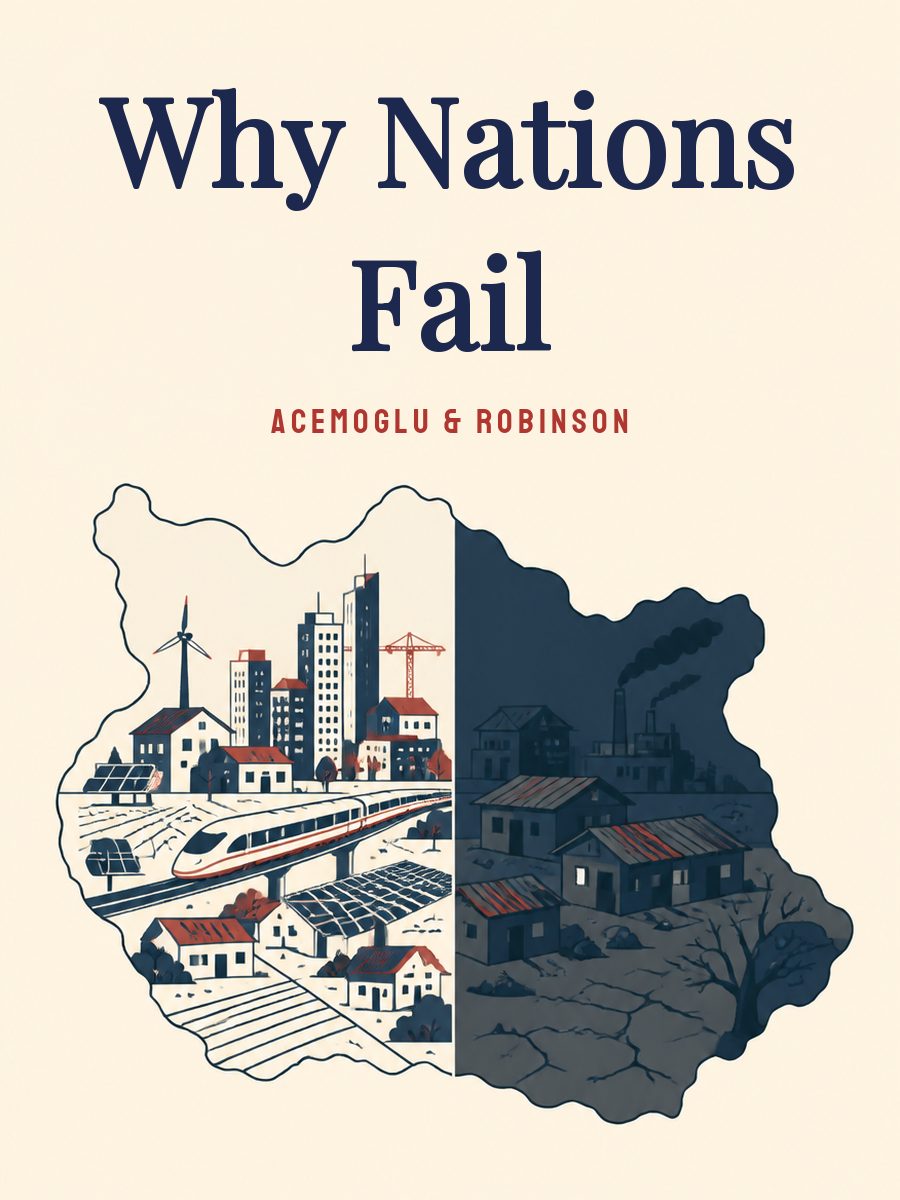 Why Nations FailDaron Acemoglu, James A. Robinson
Why do two neighboring countries with the same climate, the same history, and equally hardworking people live worlds apart — one growing rich while the other stays stuck for decades? Acemoglu and Robinson answer: it’s not about resources or mentality. It’s about who writes the rules of the game and whose interests…
Question 1 of 5
Two neighboring regions with the same climate live completely differently. According to the book, what's the reason?
Show the answer
Right answer: The rules: who holds power and whom the laws serve
The authors call this a natural experiment: if the land and culture are shared but the results differ, the cause is the rules, not the map or the mentality.
Question 2 of 5
A province passed an excellent law, but judges are appointed by the governor, a friend of a big holding company. According to the book, what will happen?
Show the answer
Right answer: The law will stay on paper: what matters is who applies it
Rules are written and applied by those with power. A perfect law is useless if those who enforce it have an interest in the opposite.
Question 3 of 5
Why does a country's elite often hold back reforms that would make the country richer?
Show the answer
Right answer: Reforms could cost them power and the income that comes with control
The book stresses that this isn't stupidity but rational fear. An elite that lives off control loses power from changes that benefit the country as a whole.
Question 4 of 5
Miners get the same pay no matter how much coal they dig. According to the book, what happens?
Show the answer
Right answer: They stop looking for ways to work better
These are extractive rules: if the fruits of your labor go to someone else, there's no point trying. Output fell even though the coal in the mine hadn't run out.
Question 5 of 5
After mass protests a new government came in. According to the book, what gives the country a chance for years to come?
Show the answer
Right answer: Building independent institutions, not just changing faces
A critical juncture works only if the new rules are locked in. If one elite just replaces another, the old trap starts up again.
Want all of the book's key ideas? Read or listen to its retelling in Livria.